
+92 331 566-8243
info@goodbloggingtools.com

15 Best Passive Income Ideas to Build Wealth

passive-income-ideas

Building wealth doesn’t always mean working longer hours, taking on a second job, or constantly chasing the next paycheck. One of the most powerful ways to improve your financial life is to create income streams that can continue generating money with less day-to-day effort over time.

That’s where passive income comes in.

Passive income is often presented online as a magical way to “make money while you sleep.” While that phrase sounds exciting, the reality is a little more practical—and much more encouraging. Most passive income streams require upfront work, money, skills, or a combination of all three. The goal isn’t to do nothing. The goal is to build something that can continue producing value without requiring you to trade every hour for every dollar.

Whether you’re starting with $0, have some savings to invest, or already run a business, there are passive income opportunities that may fit your situation.

In this guide, we’ll explore 15 of the best passive income ideas for building long-term wealth, explain how each one works, discuss the advantages and challenges, and show you how to get started.

Let’s dive in.

What Is Passive Income?

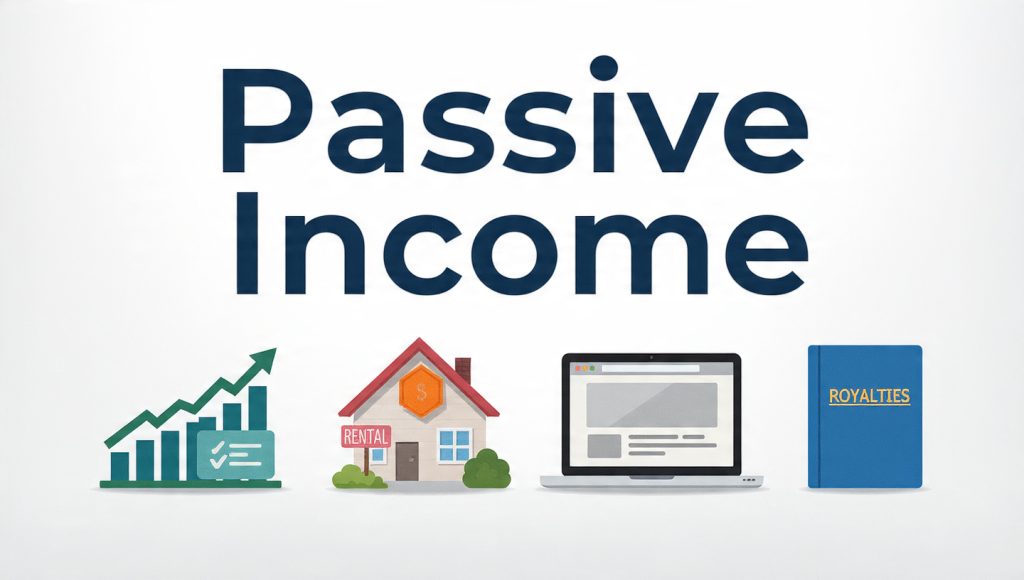
Passive income is money earned from an asset, investment, product, or system that generally requires less ongoing active work than traditional employment.

For example, if you work a regular job, you usually receive money because you actively provide your time and labor. Stop working, and the paycheck generally stops.

With passive income, you might create an asset once and continue earning from it afterward.

Examples include:

  • Interest from savings or bonds
  • Dividends from investments
  • Rental income from property
  • Royalties from intellectual property
  • Sales from digital products
  • Affiliate commissions from evergreen content
  • Advertising revenue from established websites
  • Licensing income
  • Certain automated online businesses

However, it’s important to understand that passive does not mean effortless.

A rental property may require maintenance. A blog may need occasional updates. A digital product may require customer support. An investment portfolio needs thoughtful management and periodic review.

The real benefit is leverage.

Instead of continually exchanging your time for money, you create assets that can potentially continue working for you.

Active Income vs. Passive Income

Think about the difference between these two approaches.

Active income

You work → you get paid.

Examples:

  • Salary
  • Freelancing
  • Consulting
  • Hourly work
  • Delivering services

Passive or semi-passive income

You build or purchase an asset → the asset generates income.

Examples:

  • Investments
  • Rental property
  • Digital products
  • Royalties
  • Affiliate websites

Neither approach is inherently better.

In fact, active income is often the fastest way to increase your initial capital. Passive income becomes particularly powerful when you use some of your active income to build assets.

That creates a cycle:

Earn → Save → Invest → Build assets → Generate income → Reinvest → Grow wealth

Over time, that cycle can become remarkably powerful.


1. Dividend-Paying Stocks

Dividend investing is one of the classic approaches to generating passive income.

When you purchase shares of a company that pays dividends, you may receive distributions from the company based on the number of shares you own.

For example, imagine you own shares in several established companies that distribute part of their profits to shareholders. Instead of relying entirely on selling your investments to generate cash, dividends can provide an additional income stream.

The important thing to remember is that dividends are not guaranteed. Companies can reduce, suspend, or eliminate dividends, and stock prices can fall.

Why dividend investing can be attractive

Dividend stocks can offer two potential sources of return:

  1. Dividend income
  2. Capital appreciation

Suppose you invest $10,000 and the portfolio generates a 3% annual dividend yield. Ignoring taxes, fees, and changes in the dividend, that would represent approximately $300 in annual dividend income.

The real magic can come from reinvestment.

Instead of spending the dividends, you can potentially use them to purchase additional shares. Those additional shares may then generate more dividends.

That creates a compounding effect.

How to get started

You can:

  1. Learn the basics of stock investing.
  2. Open an account with a reputable brokerage available in your country.
  3. Research diversified investments rather than blindly chasing high yields.
  4. Consider whether dividend-focused funds or ETFs are appropriate for your goals.
  5. Reinvest dividends if your objective is long-term growth.
  6. Review your portfolio periodically.

Watch out for

A very high dividend yield can sometimes be a warning sign rather than a gift.

Don’t choose an investment simply because its dividend percentage looks attractive. Consider the company’s financial health, dividend history, valuation, diversification, and overall risk.


2. High-Yield Savings Accounts and Cash Investments

If you want one of the simplest ways to generate passive income from money you already have, consider interest-bearing savings products.

A savings account may pay interest simply because you keep your money there.

This isn’t likely to make you wealthy overnight, but it can be useful for:

  • Emergency funds
  • Short-term savings
  • Cash reserves
  • Money waiting to be invested
  • Lower-risk financial goals

The advantage is simplicity.

You don’t need to create content, manage tenants, develop software, or sell products.

You deposit money, and the financial institution pays interest according to the account’s terms.

Example

If you keep $10,000 in an account earning 4% annually, the gross interest would be approximately $400 over a year, assuming the rate remained unchanged and ignoring taxes.

Of course, rates can change, and the actual return depends on the specific account and local financial system.

Best use

This strategy is generally more about preserving and growing cash safely than creating dramatic wealth.

Still, don’t underestimate small wins.

Building an emergency fund and earning interest on it can prevent you from needing expensive debt when an unexpected expense appears.


3. Bonds and Bond Funds

Bonds can provide another potential source of relatively passive income.

When you purchase a bond, you are essentially lending money to an issuer under specified terms. In return, you may receive interest payments and eventually repayment of principal if the issuer meets its obligations.

Bond investments can include:

  • Government bonds
  • Corporate bonds
  • Municipal bonds
  • Bond mutual funds
  • Bond ETFs

The risk varies considerably.

Government bonds from highly creditworthy issuers can have different risk characteristics than speculative corporate debt.

Bond funds also have risks because their prices can move as interest rates and market conditions change.

Why consider bonds?

They can potentially provide:

  • Regular interest income
  • Portfolio diversification
  • Lower volatility than some stocks, depending on the investment
  • A way to balance a broader portfolio

For someone building wealth over decades, bonds may play a role alongside other investments rather than replacing everything else.


4. Real Estate Rentals

Rental property is one of the most famous passive income strategies.

The basic model is straightforward:

Buy property → Rent it → Collect rental income → Pay expenses → Keep the remaining cash flow

But rental real estate is not completely passive.

There can be:

  • Repairs
  • Maintenance
  • Vacancy periods
  • Property taxes
  • Insurance
  • Tenant communication
  • Legal responsibilities
  • Financing costs
  • Property management

That’s why rental property is often better described as semi-passive income.

You can make it more passive by hiring a property manager, although that reduces your profit.

Why people like rental real estate

Real estate can potentially provide multiple financial benefits:

  • Rental income
  • Property appreciation
  • Potential tax advantages
  • Inflation protection in some circumstances
  • Leverage through financing

But leverage also increases risk.

If you borrow heavily and property values fall—or rental income disappears—you may still have loan payments to make.

How to approach it intelligently

Before purchasing a rental property, calculate the numbers carefully.

Consider:

  • Purchase price
  • Down payment
  • Mortgage costs
  • Expected rent
  • Vacancy
  • Maintenance
  • Insurance
  • Taxes
  • Management
  • Utilities
  • Repairs
  • Closing costs

Never assume that rent minus mortgage equals profit.


5. Real Estate Investment Trusts (REITs)

If you like the idea of real estate but don’t want to become a landlord, REITs may be worth researching.

A real estate investment trust typically owns or finances income-producing real estate.

Depending on the REIT, its properties may include:

  • Apartments
  • Shopping centers
  • Offices
  • Warehouses
  • Healthcare facilities
  • Data centers
  • Hotels
  • Industrial properties

Investors can buy shares in publicly traded REITs through brokerage accounts.

Why REITs can be appealing

You can potentially participate in real estate income without:

  • Finding tenants
  • Fixing toilets
  • Managing contractors
  • Collecting rent
  • Buying an entire building

REITs can also make real estate investing more accessible because you can generally buy smaller amounts than required for direct property ownership.

However, publicly traded REITs can fluctuate significantly in value, and distributions aren’t guaranteed.


6. Create and Sell Digital Products

This is one of the most accessible passive-income ideas for people who have knowledge, creativity, or specialized skills.

A digital product is something customers can purchase and download or access online.

Examples include:

  • Ebooks
  • Templates
  • Printables
  • Spreadsheet templates
  • Notion templates
  • Design assets
  • Photography presets
  • Educational resources
  • Business documents
  • Checklists
  • Digital planners
  • Online guides

The beauty of digital products is that you can create them once and potentially sell them many times.

Imagine spending 30 hours creating a comprehensive budgeting spreadsheet.

If 500 people eventually purchase it, you don’t need to recreate the spreadsheet 500 times.

That’s leverage.

How to get started

Start with a problem rather than a product.

Ask:

What does my target customer repeatedly struggle with?

Then create something that solves that problem.

For example:

Instead of creating a generic “business planner,” create a freelancer client-management spreadsheet that tracks projects, invoices, deadlines, and payments.

Specific solutions are often easier to market than vague ones.

Important reality

Creating the product is only half the job.

You also need traffic.

That can come from:

  • Search engines
  • Pinterest
  • Social media
  • Email marketing
  • YouTube
  • Partnerships
  • Marketplaces
  • Your own website

7. Write an Ebook

Writing an ebook can be another excellent way to turn knowledge into an income-producing asset.

You don’t need to write a 500-page masterpiece.

A useful ebook might be:

  • A practical guide
  • A beginner tutorial
  • A niche handbook
  • A recipe collection
  • A career guide
  • A hobby manual
  • A business resource
  • A problem-solving guide

The key is usefulness.

People rarely buy information simply because it exists. They buy information because they believe it will help them achieve a desired result.

A simple framework

Choose:

Audience + Problem + Solution

For example:

New bloggers + struggling with content ideas + a practical system for generating 100 blog topics.

That is much more compelling than:

“My Thoughts About Blogging.”

Make your ebook evergreen

If you want long-term sales, avoid relying entirely on temporary trends.

Evergreen subjects can continue attracting readers for years.

You may still need to update the book occasionally, especially if the topic involves technology, laws, financial rules, or rapidly changing platforms.


8. Build an Affiliate Marketing Website

Affiliate marketing allows you to earn commissions by recommending products or services.

The basic model is:

Create useful content → Recommend relevant products → Visitor clicks your affiliate link → Visitor makes a qualifying purchase → You receive a commission

For example, you could create a website about:

  • Home office equipment
  • Blogging
  • Fitness equipment
  • Gardening
  • Photography
  • Travel
  • Software
  • Personal finance
  • Crafts
  • Education

Imagine writing a helpful article titled:

“Best Budget Microphones for Home Podcasting.”

If readers click your affiliate links and make qualifying purchases, you may earn commissions.

Why affiliate marketing can become passive

A strong article can potentially attract visitors from search engines for months or years.

That means one piece of content can continue generating commissions long after you publish it.

However, affiliate income is not guaranteed.

Search rankings change. Affiliate programs change. Products disappear. Competitors publish better content.

Successful affiliate sites require maintenance.

The golden rule

Help first. Sell second.

If every article feels like a sales pitch, readers won’t trust you.

Focus on honest comparisons, useful explanations, and genuine recommendations.


9. Start a YouTube Channel

YouTube can become a long-term content asset.

The platform allows creators to publish videos that may continue attracting viewers long after publication.

Depending on eligibility and applicable policies, creators can potentially earn through:

  • Advertising
  • Sponsorships
  • Affiliate marketing
  • Memberships
  • Digital products
  • Courses
  • Merchandise

A video you publish today might receive a few hundred views this month and continue attracting viewers years later.

That is one reason YouTube can function like a library of digital assets.

Good evergreen topics

Consider subjects people will continue searching for:

  • Tutorials
  • How-to guides
  • Product education
  • Skill development
  • Software tutorials
  • DIY projects
  • Cooking
  • Educational explanations
  • Career skills

The downside

Creating good videos requires work.

You need to research topics, record footage, write scripts, edit videos, create thumbnails, and respond to your audience.

So YouTube isn’t passive at the beginning.

But a library of evergreen videos can potentially become a powerful semi-passive asset.


10. License Your Photography, Music, Art, or Designs

If you’re creative, you may be able to earn recurring income by licensing intellectual property.

Instead of selling your creative work once, licensing allows others to use it under agreed terms.

Possible assets include:

  • Photos
  • Illustrations
  • Fonts
  • Music
  • Sound effects
  • Video footage
  • Graphic designs
  • 3D models
  • Patterns
  • Digital artwork

For example, a photographer might upload images to a stock platform.

A designer might create a collection of graphics that customers can license.

A musician might license background music for videos or commercial projects.

Why licensing is powerful

Your creative work can potentially earn money repeatedly.

One photograph can be licensed many times.

One sound effect can be used by many creators.

One font can be purchased by countless designers.

The challenge is creating enough quality work and getting your portfolio discovered.


11. Create an Online Course

If you know how to teach something valuable, an online course can become a strong income-producing asset.

You might teach:

  • Graphic design
  • Coding
  • Photography
  • Marketing
  • Writing
  • Language skills
  • Crafts
  • Business skills
  • Personal development
  • Software
  • Professional skills

The course creation process can be substantial, but once your core lessons are complete, you can potentially sell access repeatedly.

A successful course solves a specific problem

Instead of:

“Learn Everything About Marketing”

consider:

“Build Your First Email Marketing Campaign in 30 Days.”

Specific outcomes are easier for students to understand.

Don’t overproduce

Your first course doesn’t need a Hollywood production budget.

Clear audio, useful instruction, logical organization, and practical examples matter more than fancy effects.


12. Build a Niche Blog

Blogging remains a potentially powerful way to build digital assets.

A blog can generate income through:

  • Display advertising
  • Affiliate marketing
  • Sponsored content
  • Digital products
  • Courses
  • Services
  • Memberships
  • Lead generation

The most valuable blogs generally aren’t trying to appeal to everyone.

They serve a specific audience.

Examples:

  • Beginner gardening
  • Home coffee brewing
  • Budget travel
  • Personal productivity
  • Pet care
  • Home organization
  • DIY woodworking
  • Small-business software
  • Hobby crafts

How blogging becomes passive

You publish useful evergreen articles.

Those articles attract visitors.

Visitors click affiliate links, view advertisements, purchase products, or join your email list.

The key word is eventually.

Most blogs don’t generate significant passive income immediately.

Building a meaningful library of content can take months or years.


13. Peer-to-Peer Lending

Peer-to-peer lending platforms allow individuals to potentially lend money to borrowers through online marketplaces.

The concept is simple:

You provide capital → borrowers repay according to the loan terms → you receive principal and interest.

However, this strategy comes with a major risk:

Borrowers may fail to repay.

Your return is therefore tied to credit risk and the platform’s structure.

Depending on where you live, regulations and availability may vary considerably.

If you consider it

Research:

  • Default rates
  • Platform history
  • Fees
  • Borrower screening
  • Expected returns
  • Liquidity
  • Legal protections
  • Tax treatment
  • Diversification

Never assume a projected return is guaranteed.

And avoid putting money into any investment you don’t understand.


14. License Software, Apps, or Digital Tools

If you have programming skills—or can work with someone who does—you can build software that generates recurring revenue.

Examples include:

  • Mobile apps
  • Browser extensions
  • SaaS tools
  • WordPress plugins
  • Shopify apps
  • Productivity tools
  • Calculators
  • Business software
  • Automation tools

Software can be particularly attractive because the same digital product can serve thousands of customers.

Imagine creating a tool that solves a small but annoying problem for businesses.

If 1,000 customers each pay $10 per month, that represents $10,000 in monthly recurring revenue before expenses, taxes, refunds, payment costs, and other overhead.

Of course, reaching that point is difficult.

Software businesses require:

  • Development
  • Customer support
  • Security
  • Updates
  • Marketing
  • Infrastructure
  • Bug fixes

So this is usually semi-passive, not completely passive.

Still, software has tremendous scalability.


15. Build a Print-on-Demand Business

Print-on-demand allows you to sell products without keeping traditional inventory.

You create designs.

A customer places an order.

A third-party company prints and ships the product.

Products might include:

  • T-shirts
  • Hoodies
  • Mugs
  • Posters
  • Tote bags
  • Phone cases
  • Wall art
  • Stationery

The appeal is that you don’t necessarily need to purchase hundreds of products upfront.

How to make it more passive

The goal is to build a catalog.

Instead of relying on one design, create dozens or hundreds of useful or appealing designs for a specific audience.

For example:

Niche: Gardening enthusiasts

Possible products:

  • Gardening shirts
  • Garden-themed mugs
  • Botanical wall art
  • Plant-lover gifts
  • Garden journals

The more relevant products you have, the more opportunities you create for sales.

The challenge

Competition is intense.

Successful print-on-demand businesses typically require:

  • Strong designs
  • Good product descriptions
  • Search optimization
  • High-quality mockups
  • Niche research
  • Customer service
  • Consistent testing

And always respect copyright and trademark rules.


How to Choose the Best Passive Income Idea for You

With 15 options on the table, you might be wondering:

Which one should I choose?

The answer depends on your resources.

There is no universal “best” passive income strategy.

The right choice depends on your:

  • Starting capital
  • Skills
  • Available time
  • Risk tolerance
  • Interests
  • Existing audience
  • Business experience
  • Long-term goals

Let’s simplify it.

If You Have Little or No Money

Focus on skill-based assets.

Consider:

  • Digital products
  • Blogging
  • Affiliate marketing
  • YouTube
  • Online courses
  • Ebooks
  • Licensing creative work
  • Print-on-demand

These generally require more time than capital.


If You Have Capital but Little Time

Consider investment-based approaches.

Potential options include:

  • Diversified stock investments
  • Dividend-focused investments
  • Bonds
  • REITs
  • Interest-bearing cash accounts

You may still need to research your options carefully, but these approaches can require less day-to-day work than building a content business.


If You Have Technical Skills

Consider:

  • Software
  • Apps
  • SaaS products
  • Digital tools
  • Online courses
  • Technical ebooks

Technical knowledge can be converted into scalable digital assets.


If You’re Creative

Consider:

  • Digital art
  • Photography licensing
  • Print-on-demand
  • Design templates
  • Fonts
  • Music licensing
  • Ebooks
  • Online courses

Creativity can become an asset rather than simply a hobby.


If You Have an Audience

If you already have followers, subscribers, website visitors, or an email list, you have an enormous advantage.

You can potentially monetize your audience through:

  • Affiliate products
  • Digital products
  • Courses
  • Memberships
  • Sponsorships
  • Advertising

An audience itself can become a valuable business asset.


The Most Powerful Passive Income Strategy: Combine Multiple Streams

You don’t necessarily need 15 income streams.

In fact, trying to build all 15 at once is usually a terrible idea.

Instead, consider building one strong income stream and gradually adding complementary ones.

For example:

Blog

Affiliate marketing

Email newsletter

Digital product

Online course

YouTube channel

Each asset can support the others.

A blog article can attract someone to your website.

The website can encourage them to join your email list.

Your email list can introduce them to your ebook.

Your ebook can lead them to your course.

Your YouTube videos can bring more people into the entire system.

That’s how a collection of small assets can become a larger business ecosystem.


The Passive Income Flywheel

A useful way to think about passive income is as a flywheel.

Step 1: Learn

Develop a valuable skill.

Step 2: Create

Turn that skill into an asset.

Step 3: Publish

Put the asset where people can discover it.

Step 4: Monetize

Add an appropriate revenue model.

Step 5: Improve

Use feedback and data to make it better.

Step 6: Reinvest

Put some of the income into additional assets.

Step 7: Repeat

Over time, you build a portfolio of income-producing assets.

This is much more realistic than searching for a secret “money while you sleep” trick.


How Much Money Do You Need to Start?

One of the biggest myths about passive income is that you need a huge amount of money.

That’s not always true.

Some strategies require substantial capital.

For example:

  • Real estate
  • Large investment portfolios
  • Certain business acquisitions

Others can be started with relatively little money:

  • Blogging
  • Affiliate marketing
  • Digital products
  • YouTube
  • Ebooks
  • Print-on-demand
  • Online courses

Your primary investment may be time and learning.

This leads to an important principle:

If you don’t have money, use time and skills. If you have money but little time, consider using capital to acquire assets.

Of course, your personal situation and risk tolerance matter.


Passive Income Isn’t Really Passive at First

This point deserves repeating.

Many successful passive-income streams begin as active projects.

A blog requires writing.

A YouTube channel requires filming.

A course requires teaching.

A digital product requires creation.

A rental property requires acquisition and management.

A portfolio requires research and planning.

The passive element comes later, when the asset is established and can generate returns without requiring proportional increases in your labor.

Think of it like planting a tree.

You prepare the soil.

You plant the seed.

You water it.

You protect it.

You wait.

Eventually, the tree becomes large enough to provide shade.

Passive income often works the same way.


How to Avoid Passive Income Scams

Unfortunately, the popularity of passive income has created plenty of misleading opportunities.

Be skeptical of claims such as:

  • “Guaranteed $500 per day”
  • “No work required”
  • “Get rich overnight”
  • “Secret loophole”
  • “Guaranteed returns”
  • “Anyone can make $10,000 this month”
  • “Zero risk”
  • “Copy my system and become wealthy”

Real wealth building is usually much less exciting.

It often looks like:

Small improvements repeated consistently over many years.

Before investing money into an opportunity, ask:

  1. How does the business actually make money?
  2. Where does the return come from?
  3. What are the risks?
  4. What happens if the market changes?
  5. Are there hidden fees?
  6. Is the income guaranteed?
  7. Can I verify the claims independently?
  8. Do I understand what I’m buying?

If you can’t explain how the opportunity generates money, don’t invest simply because someone promises impressive returns.


How to Build Passive Income With a Full-Time Job

You don’t need to quit your job.

In fact, keeping your primary income can be one of the smartest approaches while building passive income.

Your job provides:

  • Regular cash flow
  • Savings capacity
  • Stability
  • Benefits in some cases
  • Capital for investments

You can dedicate a few hours each week to building an asset.

For example:

Monday

Research one content topic.

Wednesday

Create the content.

Saturday

Publish and promote it.

Sunday

Review performance and plan the next piece.

Small, consistent effort can accumulate.

You don’t need to build an empire in 30 days.

You need to keep moving forward.


A Simple 12-Month Passive Income Plan

If you’re starting from scratch, here’s a practical framework.

Months 1–2: Choose One Strategy

Don’t choose five.

Choose one.

Ask yourself:

  • What do I know?
  • What do I enjoy?
  • What problem can I solve?
  • What resources do I have?
  • How much time can I realistically commit?

Months 3–4: Build the First Asset

Create something tangible.

Examples:

  • Ten high-quality blog posts
  • Your first ebook
  • Your first digital product
  • Ten useful YouTube videos
  • Your first online course
  • A small investment portfolio

Focus on quality rather than perfection.


Months 5–6: Start Distribution

Creating something isn’t enough.

Find people who need it.

Use:

  • SEO
  • Social media
  • Email
  • Communities
  • Partnerships
  • Video
  • Pinterest
  • Search-driven content

Months 7–9: Improve

Look at what is working.

Ask:

  • Which pages get traffic?
  • Which products sell?
  • Which videos get views?
  • Which emails get clicks?
  • Which topics attract people?

Do more of what works.


Months 10–12: Add a Second Revenue Stream

Once the first system is functioning, add something complementary.

For example:

Blog → Affiliate marketing → Digital product

or:

YouTube → Affiliate marketing → Course

or:

Creative portfolio → Licensing → Digital products

The goal isn’t complexity.

The goal is leverage.


How to Reinvest Passive Income

One of the biggest mistakes people make is immediately spending every dollar of passive income.

If your goal is wealth building, consider reinvesting at least part of your income.

For example:

Passive income → Investments → More assets → More income

Suppose a digital product generates $300.

You could potentially use part of that money to:

  • Improve the product
  • Create another product
  • Invest in your portfolio
  • Build an email list
  • Improve your website
  • Purchase better equipment
  • Learn a valuable skill

The specific choice depends on your circumstances.

The broader principle is simple:

Use today’s income to increase tomorrow’s earning capacity.


Why Compounding Matters So Much

Compounding is one of the most powerful concepts in wealth building.

When your investment earns a return and you reinvest that return, your future returns can be generated from both your original money and previous earnings.

For example:

You invest money.

It earns returns.

You reinvest those returns.

The larger balance generates additional returns.

You reinvest again.

Over many years, the growth can become increasingly significant.

This is why starting early can matter more than trying to find the perfect investment.

Time is one of your greatest assets.


Don’t Confuse Income With Wealth

This is another important distinction.

Someone can generate $10,000 per month and still have little wealth if they spend $10,000 every month.

Another person might earn $5,000 per month but consistently save and invest a significant portion.

Wealth is not simply about income.

It’s about the relationship between:

Income + Expenses + Assets + Liabilities + Time

Passive income can help because it potentially allows you to earn money from assets rather than relying exclusively on active labor.

But the income itself is only useful if you manage it wisely.


The Best Passive Income Ideas at a Glance

Passive Income IdeaStarting CapitalTime RequiredScalabilityRisk
Dividend InvestmentsMediumLowHighMarket risk
Interest-Bearing SavingsLow–MediumVery LowModerateLow to moderate
BondsLow–MediumLowModerateVaries
Rental PropertyHighMediumHighProperty/market risk
REITsLow–MediumLowHighMarket risk
Digital ProductsLowMediumVery HighBusiness risk
EbooksLowMediumHighBusiness risk
Affiliate WebsitesLowHigh initiallyHighPlatform/traffic risk
YouTubeLowHigh initiallyVery HighPlatform/business risk
Creative LicensingLowMediumHighDemand risk
Online CoursesLow–MediumHigh initiallyVery HighBusiness risk
Niche BloggingLowHigh initiallyHighTraffic risk
Peer-to-Peer LendingMediumLowModerateDefault risk
Software/AppsMediumHigh initiallyVery HighBusiness/technical risk
Print-on-DemandLowMediumHighCompetition risk

The table isn’t a ranking because the “best” strategy depends on your circumstances.


10 Rules for Building Passive Income Successfully

Rule 1: Start Small

Your first goal isn’t to make $10,000 per month.

Your first goal is to make your first dollar.

That proves your idea can generate revenue.


Rule 2: Focus on Assets

Ask:

What can I build today that might still be valuable one year from now?

That question changes your mindset.


Rule 3: Solve Real Problems

People pay for solutions.

Don’t create something simply because you think it’s interesting.

Find a genuine problem and solve it.


Rule 4: Don’t Chase Trends Blindly

Trends can produce opportunities, but evergreen markets can provide more durable foundations.

Look for problems people will continue to have.


Rule 5: Diversify Carefully

Diversification can reduce dependence on a single income source, but spreading yourself across too many projects can also destroy your focus.

Build one strong stream first.


Rule 6: Reinvest

Use some of your profits to build additional assets.


Rule 7: Protect Your Downside

Don’t put money into investments you don’t understand.

Don’t borrow aggressively just to chase passive income.

Don’t risk your emergency fund on speculative opportunities.


Rule 8: Track Your Numbers

Know:

  • Revenue
  • Expenses
  • Profit
  • Conversion rate
  • Investment returns
  • Taxes
  • Customer acquisition costs

What gets measured can be improved.


Rule 9: Be Patient

Most passive-income success stories are years in the making.

Don’t quit after three weeks because your website isn’t generating thousands of dollars.


Rule 10: Think Long Term

The goal isn’t simply to make money.

The goal is to build financial resilience and long-term wealth.


Which Passive Income Ideas Are Most Beginner-Friendly?

If you’re completely new, consider starting with something relatively simple.

Beginner option #1: Digital products

Create a useful template, guide, spreadsheet, or printable.

Beginner option #2: Affiliate content

Write or create useful content around products you genuinely understand.

Beginner option #3: Investing

Learn the fundamentals and gradually build a diversified portfolio appropriate for your circumstances.

Beginner option #4: Blogging

Choose a focused niche and build a library of genuinely helpful content.

Beginner option #5: YouTube

Teach something you already know.

The common thread is that none of these requires you to become wealthy before starting.


What If You Have No Skills?

You don’t need to start as an expert.

You can learn.

Choose one valuable skill and spend several months developing it.

Potential skills include:

  • Writing
  • Graphic design
  • Video editing
  • Programming
  • SEO
  • Photography
  • Teaching
  • Marketing
  • Data analysis
  • Copywriting

Then turn that skill into an asset.

For example:

Learn design → create templates → sell templates → build an audience → create a course

That’s a realistic progression.


Passive Income and Financial Freedom

Financial freedom means different things to different people.

For one person, it might mean covering the grocery bill through investments.

For another, it might mean replacing a full-time salary.

For someone else, it might mean having enough assets to choose whether or not to work.

You don’t have to replace your entire income to benefit from passive income.

Even an additional $100 per month can be useful.

Imagine eventually building:

  • $100/month from investments
  • $150/month from affiliate income
  • $200/month from digital products
  • $100/month from royalties

That’s $550 per month across several sources.

Over a year, that’s $6,600 before applicable taxes, expenses, and fluctuations.

The amounts may start small, but the principle is powerful.


The Biggest Mistake: Looking for the Easiest Option

The easiest passive-income strategy is often the least profitable.

Why?

Because low barriers attract competition.

If someone tells you that you can make thousands of dollars with five minutes of work per day, thousands of other people are probably being told the same thing.

Instead, look for the intersection of:

Your skills + Market demand + Scalability + Sustainability

That’s where the real opportunities tend to be.


Final Thoughts: Build Wealth One Asset at a Time

Passive income isn’t a shortcut to wealth.

It’s a strategy for creating leverage.

The most successful approach is usually not to chase every opportunity that promises easy money. Instead, choose one realistic path, learn the fundamentals, build something valuable, and keep improving it.

If you have capital, investments may help your money work harder.

If you have skills, digital products and content can turn those skills into scalable assets.

If you have creativity, licensing and print-on-demand can create additional revenue opportunities.

If you have technical knowledge, software can potentially become a highly scalable business.

And if you don’t have much money or experience yet, that’s okay.

Start with what you have.

Your first passive-income project doesn’t need to make thousands of dollars.

It needs to teach you how to create an asset.

Then create another.

And another.

Over time, those assets can begin working together.

That’s the real opportunity behind passive income.

Don’t focus only on making more money today. Focus on building things that can continue creating value tomorrow.

Because wealth is rarely built through one spectacular move.

It’s more often built through small, intelligent decisions repeated consistently for years.

And the sooner you start, the more time you give those decisions to compound.

Leave a Reply

Your email address will not be published. Required fields are marked *