
If you are serious about growing a website through search engines, sooner or later you will probably run into the same question: Should I use Ahrefs or SEMrush?
Both platforms have become household names in the SEO world. Both offer powerful keyword research, competitor analysis, backlink data, site audits, rank tracking, content research, and a growing collection of tools designed to help businesses attract more organic traffic.
And that is exactly what makes the decision difficult.
At first glance, Ahrefs and SEMrush can look remarkably similar. You can enter a domain, investigate its organic traffic, discover keywords, analyze backlinks, research competitors, and find opportunities to improve your rankings.
But once you spend time inside both platforms, their differences become much clearer.
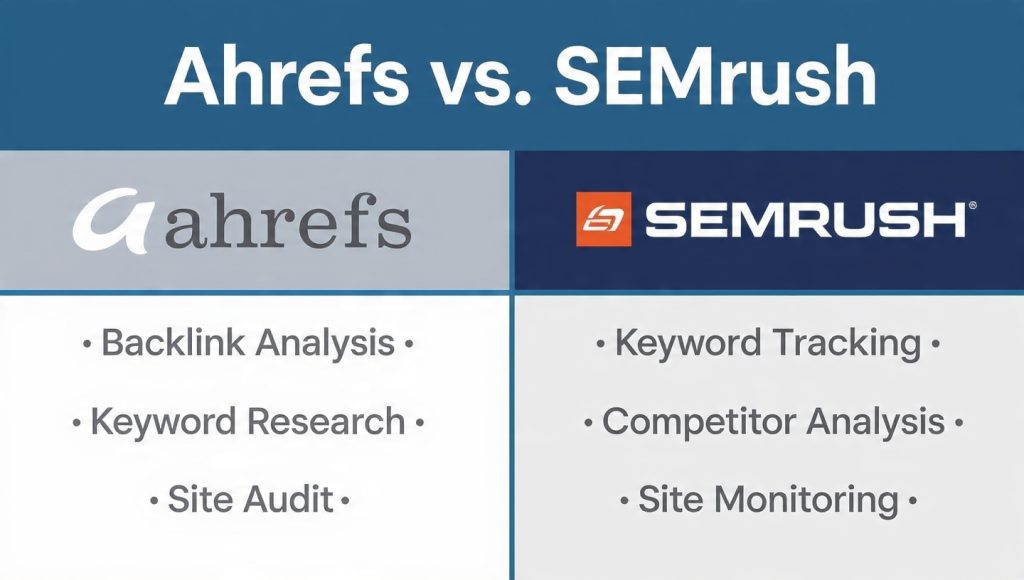
Ahrefs tends to feel especially strong for backlink research, organic search analysis, content exploration, and straightforward SEO workflows. SEMrush is broader, with a particularly strong focus on keyword research, competitive intelligence, rank tracking, local and paid-search capabilities, content marketing, and all-in-one digital marketing workflows.
So which one is worth your money?
The honest answer is: it depends on what you need the tool to do.
For a blogger who primarily wants keyword ideas and backlink opportunities, one platform may be the better investment. For an agency managing SEO, PPC, content, local search, and multiple clients, the other may make more sense.
In this guide, we will compare Ahrefs and SEMrush in detail, look at their major features, discuss their strengths and weaknesses, explain which type of user each platform suits best, and help you decide where your SEO budget is likely to be better spent.
Ahrefs vs. SEMrush at a Glance
Before getting into the details, here is the simple version.
| Category | Ahrefs | SEMrush |
|---|---|---|
| Keyword research | Excellent | Excellent |
| Backlink analysis | Excellent | Excellent |
| Site audits | Excellent | Excellent |
| Competitor research | Excellent | Excellent |
| Rank tracking | Excellent | Excellent |
| Content research | Excellent | Excellent |
| PPC research | Limited compared with SEMrush | Excellent |
| Local SEO | Growing capabilities | Very strong |
| Content marketing | Strong | Very strong |
| Ease of use | Generally clean and focused | Powerful but broader |
| Agency features | Strong | Excellent |
| Digital marketing breadth | Strong | Excellent |
| Best for | SEO-focused users | Broader marketing teams |
| Learning curve | Moderate | Moderate to high |
| Overall value | Excellent for SEO specialists | Excellent for all-in-one marketers |
There is no universal winner.
Instead, think of the platforms this way:
Ahrefs is an SEO powerhouse.
SEMrush is a broader digital marketing powerhouse.
That distinction becomes important when deciding which subscription deserves a place in your monthly budget.
What Are Ahrefs and SEMrush?
Let’s start with the basics.
Ahrefs and Semrush are both professional software platforms designed to help marketers understand search engines and improve website performance.
At their core, both platforms collect enormous amounts of search and web data and turn that information into practical marketing tools.
You can use them to answer questions such as:
- Which keywords should I target?
- How difficult will it be to rank for a keyword?
- Which pages bring competitors the most organic traffic?
- Where are my competitors getting backlinks?
- Which websites link to my competitors but not to me?
- Why is my website losing rankings?
- Which pages on my site have technical SEO problems?
- How is my website performing in Google?
- What content should I create next?
- Which keywords are competitors ranking for?
- What websites compete with me?
- What topics are generating search demand?
- Which pages are gaining or losing visibility?
Both platforms can answer many of these questions.
The difference is how they approach the answers and how much additional marketing functionality they provide around them.
Why Choosing the Right SEO Tool Matters
SEO tools are not inexpensive toys.
If you are running a serious website, agency, ecommerce store, affiliate site, SaaS company, local business, or content publication, an SEO platform can become part of your everyday workflow.
That means the wrong choice can become expensive in two ways.
First, there is the subscription cost.
Second, there is the opportunity cost.
If your tool is difficult to use, lacks the data you need, or provides features you never touch, you may spend money without getting much value in return.
On the other hand, the right SEO platform can save you hours of manual research.
Instead of guessing which keywords might work, you can investigate search demand and competition.
Instead of manually checking hundreds of websites for backlinks, you can analyze backlink profiles in minutes.
Instead of wondering what competitors are doing, you can study their strongest pages, keywords, links, and content strategies.
That is why the best SEO tool is not necessarily the one with the longest feature list.
It is the one that helps you make better decisions faster.
Ahrefs: What Makes It Stand Out?
Ahrefs has built a particularly strong reputation around SEO.
The platform is widely associated with backlink analysis, organic search research, content research, keyword analysis, and website auditing.
Its interface generally feels designed around people whose primary objective is improving organic search visibility.
One of the biggest advantages of Ahrefs is that many SEO workflows feel relatively direct.
You can enter a website and quickly move into:
- Organic keywords
- Top pages
- Competing domains
- Backlinks
- Referring domains
- Keyword opportunities
- Content opportunities
- Site health
- Rank tracking
For SEO professionals, that focus can be extremely valuable.
You are not necessarily navigating through a huge marketing suite just to complete a simple SEO task.
SEMrush: What Makes It Stand Out?
SEMrush takes a somewhat broader approach.
SEO remains a major part of the platform, but SEMrush has expanded into areas such as:
- Keyword research
- Competitive intelligence
- PPC research
- Content marketing
- Local SEO
- Social media marketing
- Rank tracking
- Technical SEO
- Market research
- Advertising analysis
- Agency workflows
This makes SEMrush particularly attractive if your marketing strategy goes beyond organic search.
For example, imagine you are managing an ecommerce company.
You may want to:
- Research organic keywords.
- Analyze competitors.
- Track rankings.
- Investigate paid search competitors.
- Create content briefs.
- Monitor local visibility.
- Track marketing performance.
SEMrush can bring many of those activities into one ecosystem.
That breadth is one of its biggest selling points.
Keyword Research: Ahrefs vs. SEMrush
Keyword research is one of the first areas most users investigate.
And both platforms are extremely capable.
The basic goal is simple:
Find search queries that are relevant, valuable, and realistically achievable.
But good keyword research involves much more than finding keywords with large search volumes.
You also need to consider:
- Search intent
- Keyword difficulty
- Competition
- Traffic potential
- Business value
- Existing SERP results
- Related topics
- Long-tail variations
- Commercial intent
- Content type
Both Ahrefs and SEMrush provide substantial data to help with this process.
Ahrefs Keyword Research
Ahrefs has historically been particularly popular among SEO professionals for keyword research.
Its keyword database allows users to explore:
- Search volume
- Keyword difficulty
- Traffic potential
- Parent topics
- Related terms
- Search engine result pages
- Ranking pages
- Click-related metrics
- Keyword variations
One particularly useful concept is Traffic Potential.
Search volume alone can be misleading.
Imagine a keyword receives 5,000 searches per month. That sounds attractive.
But perhaps the page ranking first for that keyword also ranks for hundreds of closely related queries.
That means the total traffic opportunity from creating a strong page may be much larger than the search volume of the primary keyword suggests.
This is an important way of thinking about modern SEO.
You are not simply targeting isolated keywords.
You are building pages that can satisfy a broader search topic.
SEMrush Keyword Research
SEMrush’s keyword research capabilities are also extremely comprehensive.
Its keyword database can help you investigate:
- Search volume
- Keyword difficulty
- Search intent
- Competitive density
- Keyword variations
- Related keywords
- Question keywords
- SERP features
- Trends
- Keyword gaps
One of SEMrush’s major strengths is the way keyword research connects with competitive intelligence.
You can investigate what competitors rank for and identify opportunities where your website may be missing.
That can make the process of moving from keyword discovery to competitive analysis very efficient.
Which Is Better for Keyword Research?
This is a close competition.
If you primarily think like an SEO specialist, Ahrefs may feel more intuitive.
If you want keyword research integrated into a wider competitive and marketing ecosystem, SEMrush may have the edge.
For most users, however, the difference is not dramatic enough to make keyword research alone the deciding factor.
The better choice may come down to your overall workflow.
Backlink Analysis: Ahrefs vs. SEMrush
This is where Ahrefs has historically built one of its strongest reputations.
Backlinks remain an important part of SEO because links can help search engines understand relationships, authority, and credibility across the web.
A good backlink tool allows you to investigate:
- Who links to your website?
- Which pages receive the most links?
- Which competitors have stronger backlink profiles?
- Which websites link to competitors but not you?
- What anchor text is being used?
- Which links are new?
- Which links have disappeared?
- Which referring domains are most valuable?
Ahrefs Backlink Research
Ahrefs is particularly well known for its backlink analysis capabilities.
Its backlink-focused tools make it easy to explore a website’s link profile and discover potential link-building opportunities.
You can investigate competitors and ask:
“Who is linking to them that might also be relevant to me?”
That question alone can produce a tremendous number of useful ideas.
For example, suppose you run a website about personal finance.
You find that a competing article has earned links from:
- Financial blogs
- Universities
- Industry publications
- News websites
- Resource pages
- Professional organizations
Instead of blindly building links, you can study why those websites linked to the competitor.
Maybe the competitor created an original study.
Maybe it published a useful calculator.
Maybe it produced a detailed resource.
Maybe it simply had the best explanation available.
That information can influence your own content strategy.
SEMrush Backlink Analysis
SEMrush also provides substantial backlink analysis capabilities.
Its backlink tools allow you to investigate:
- Referring domains
- Backlink types
- Anchor text
- Authority metrics
- New backlinks
- Lost backlinks
- Competitor links
- Link gaps
The platform can also help identify opportunities for building backlinks by comparing your link profile with competitors.
For agencies, that broader integration can be especially useful.
Which Is Better for Backlinks?
If backlink analysis is one of the main reasons you’re buying an SEO platform, Ahrefs deserves serious consideration.
It has long been one of its defining strengths.
SEMrush is absolutely capable in this area, but users who spend a large portion of their time conducting backlink research often gravitate toward Ahrefs.
Winner for backlink-focused SEO: Ahrefs.
Competitor Analysis: Ahrefs vs. SEMrush
Competitor research is another area where both tools shine.
And it can be one of the most valuable uses of an SEO platform.
Instead of asking:
“What should I write about?”
You can ask:
“What is already working for websites competing with me?”
That changes everything.
Competitor Research With Ahrefs
Ahrefs allows you to analyze competing websites and investigate:
- Organic keywords
- Top-performing pages
- Backlinks
- Referring domains
- Content performance
- Competing pages
- Keyword intersections
- Organic traffic trends
One of the most useful approaches is to find competitors’ top pages.
Imagine you operate a website about home fitness.
You could enter a competing site and discover that its most successful pages are about:
- Beginner workouts
- Home gym equipment
- Resistance-band exercises
- Workout schedules
- Protein-rich meals
Now you have clues about the topics attracting search traffic in your market.
You can then investigate those topics further instead of creating content based purely on intuition.
Competitor Research With SEMrush
SEMrush takes competitor research very seriously.
You can investigate competitors across multiple marketing channels, depending on the tools and subscription features available to you.
This can include:
- Organic search
- Paid search
- Keyword rankings
- Advertising competitors
- Backlinks
- Content
- Market trends
- Traffic-related insights
This broader competitive intelligence can be especially valuable for companies running multiple marketing channels.
Which Is Better for Competitor Analysis?
For pure SEO competitor analysis, both are excellent.
For broader digital competitor intelligence, SEMrush often has the advantage.
If your business competes through organic search, paid search, content, and other digital channels, having a wider view can be incredibly useful.
Winner for broader competitive intelligence: SEMrush.
Site Auditing: Ahrefs vs. SEMrush
Technical SEO can become complicated quickly.
Your content may be excellent, but technical problems can still make it harder for search engines to crawl, understand, or index your website.
Common technical issues include:
- Broken links
- Redirect problems
- Missing metadata
- Duplicate content
- Slow pages
- Crawlability problems
- Canonical issues
- Orphan pages
- Incorrect status codes
- Indexation problems
- Missing structured data
- Internal linking problems
Both Ahrefs and SEMrush provide website auditing tools.
Ahrefs Site Audit
Ahrefs’ Site Audit tool crawls your website and identifies a broad range of technical and on-page SEO issues.
It can help you understand:
- Site health
- Broken pages
- Redirect chains
- Metadata problems
- HTML issues
- Internal links
- Performance-related problems
- Indexability issues
The reports are particularly useful when you want to turn technical SEO into an actionable to-do list.
SEMrush Site Audit
SEMrush’s Site Audit is also comprehensive.
It can identify numerous technical SEO problems and organize them into categories based on severity and type.
The broader SEMrush ecosystem can make it convenient to move from an audit into other marketing activities.
For example, you might identify a technical problem, then use other SEMrush tools to investigate rankings, keywords, competitors, or content.
Which Is Better for Technical SEO?
There is no overwhelming winner here.
Both platforms can perform serious technical audits.
For many businesses, the deciding factor will be the interface, reporting preferences, and the rest of the platform rather than audit capability alone.
Winner: Tie.
Rank Tracking: Ahrefs vs. SEMrush
Rank tracking sounds simple:
“Where does my website rank for my keywords?”
But professional rank tracking is much more sophisticated than manually searching Google.
You may want to track:
- Hundreds or thousands of keywords
- Desktop rankings
- Mobile rankings
- Different locations
- Competitor rankings
- SERP features
- Ranking changes
- Visibility trends
- Specific landing pages
Both Ahrefs and SEMrush offer rank tracking.
Ahrefs Rank Tracker
Ahrefs Rank Tracker allows you to monitor keyword performance over time.
You can track rankings across different search engines, locations, devices, and competitors depending on the account and setup.
This helps answer questions such as:
- Did my rankings improve after publishing new content?
- Which keywords are falling?
- Which pages are gaining visibility?
- Which competitors are overtaking me?
- Are my rankings different on mobile?
SEMrush Position Tracking
SEMrush’s Position Tracking is another mature rank-tracking solution.
It offers detailed monitoring of keyword positions and visibility and provides competitive comparison features.
For agencies and larger teams, reporting functionality can be particularly important.
Which Has Better Rank Tracking?
Both are very strong.
SEMrush may have an advantage for users who want extensive reporting and broader marketing integration.
Ahrefs is excellent for users who prefer a focused SEO environment.
Again, the winner depends more on your workflow than on a huge capability gap.
Content Research: Ahrefs vs. SEMrush
Modern SEO is increasingly about creating genuinely useful content rather than simply placing keywords into articles.
You need to understand:
- What people are searching for
- What questions they have
- What content already exists
- What competitors cover
- What information is missing
- What search intent looks like
- What topics deserve deeper coverage
Both Ahrefs and SEMrush can help.
Ahrefs for Content Research
Ahrefs can help you discover popular content, investigate competing pages, and identify content opportunities.
You can study pages that attract:
- Organic traffic
- Backlinks
- Social attention
- Search visibility
This can be especially helpful when you want to create content that has both search and link potential.
SEMrush for Content Marketing
SEMrush has invested heavily in content marketing functionality.
Depending on the tools available in your plan, you can use the platform to support processes such as:
- Topic research
- Content planning
- Content optimization
- Writing assistance
- Content briefs
- SEO recommendations
This makes SEMrush appealing to content teams that want more than keyword research.
Which Is Better for Content Marketing?
If your primary concern is discovering successful pages and analyzing content from an SEO perspective, Ahrefs is excellent.
If you want a wider content marketing workflow, SEMrush may have the advantage.
Winner for broader content marketing workflows: SEMrush.
PPC and Paid Search: A Major Difference
This is one of the most important differences between the platforms.
If you are primarily interested in organic SEO, this may not matter much.
But if you manage Google Ads or other paid search campaigns, it matters a lot.
SEMrush has a substantial ecosystem around paid search and advertising research.
You can investigate competitor advertising strategies, keywords, ad-related data, and other paid-search insights.
Ahrefs is much more focused on organic search and SEO.
That does not make Ahrefs worse.
It simply means the platforms have different priorities.
If you run both SEO and PPC campaigns, SEMrush can provide a more complete view of your search marketing environment.
Winner for PPC research: SEMrush.
Local SEO: Ahrefs vs. SEMrush
Local SEO is another area where the platforms differ.
If you run a local business, you may care about:
- Google Business Profile visibility
- Local rankings
- Local competitors
- Reviews
- Citation management
- Local keywords
- Map visibility
- Location-specific reporting
SEMrush has developed a substantial set of local marketing capabilities.
This can make it attractive for:
- Restaurants
- Dentists
- Lawyers
- Contractors
- Real estate businesses
- Medical practices
- Retail stores
- Agencies managing local clients
Ahrefs remains extremely useful for local SEO keyword and competitor research, but SEMrush’s broader local marketing ecosystem can be appealing.
Winner for broader local SEO workflows: SEMrush.
Ease of Use: Which Feels Better?
This is subjective, but it matters.
A tool can have hundreds of features and still be frustrating if you cannot quickly find what you need.
Ahrefs is often appreciated for its relatively focused SEO experience.
The platform tends to feel like it was built for people who live and breathe search.
SEMrush offers more functionality across a wider marketing landscape.
That is powerful.
But more functionality can also mean more complexity.
For a beginner, SEMrush can sometimes feel overwhelming simply because there is so much to explore.
For a marketing team, however, that complexity may be worthwhile.
Think of it this way:
Ahrefs can feel like a specialized professional workshop.
SEMrush can feel like a complete marketing department in one platform.
Neither approach is inherently better.
It depends on what you value.
Ahrefs vs. SEMrush for Bloggers
If you are a blogger, your needs may be surprisingly simple.
You might mainly want to:
- Find keywords
- Analyze competitors
- Discover content ideas
- Track rankings
- Find backlink opportunities
- Audit your website
If that describes you, Ahrefs can be an excellent choice.
Its SEO-first approach makes sense for bloggers who are primarily concerned with organic traffic.
However, SEMrush can also be an excellent choice if you want stronger content marketing capabilities or plan to expand into paid advertising.
Best choice for many SEO-focused bloggers:
Ahrefs
Best choice for bloggers building a broader marketing operation:
SEMrush
Ahrefs vs. SEMrush for Affiliate Marketers
Affiliate marketers often care deeply about:
- Keyword research
- Search intent
- Competitor analysis
- Content gaps
- Backlinks
- Ranking opportunities
- Traffic potential
That makes Ahrefs particularly attractive.
For example, you can identify competitors in your niche, analyze their strongest pages, study the keywords those pages rank for, and investigate their backlinks.
You can then build a content plan based on actual search data.
SEMrush is also very capable, especially if affiliate marketing is combined with paid advertising.
But if SEO is the heart of your affiliate business, Ahrefs is a natural fit.
Ahrefs vs. SEMrush for Ecommerce
Ecommerce websites often need a more diverse marketing toolkit.
You may need:
- Product keyword research
- Competitor research
- Technical SEO
- Content optimization
- PPC research
- Local visibility
- Market research
- Rank tracking
SEMrush’s broader ecosystem can be particularly attractive here.
However, Ahrefs can be excellent for ecommerce SEO, especially when your strategy revolves around organic content, category pages, product research, and backlink acquisition.
SEO-first ecommerce strategy:
Ahrefs
SEO + PPC + broader digital marketing:
SEMrush
Ahrefs vs. SEMrush for Agencies
Agencies have different needs from individual website owners.
An agency may manage:
- Dozens of websites
- Multiple clients
- Monthly SEO reports
- Keyword tracking
- Competitor analysis
- Technical audits
- Local SEO
- Content
- PPC
- Client communication
For this type of environment, SEMrush’s broader marketing capabilities can be extremely valuable.
The platform’s reporting and multi-channel capabilities can help agencies consolidate workflows.
Ahrefs is also widely useful for agencies, particularly SEO-focused agencies.
But if your agency provides services beyond SEO, SEMrush may be the more versatile investment.
Ahrefs vs. SEMrush for SEO Professionals
For an SEO specialist who spends most of the day analyzing organic search, Ahrefs is difficult to ignore.
It offers an excellent combination of:
- Keyword research
- Backlink analysis
- Competitor analysis
- Content research
- Technical auditing
- Rank tracking
SEMrush is also highly capable, but its broader scope may be less important if your work is almost entirely organic SEO.
If you are an SEO consultant who rarely touches PPC, social media, or broader marketing operations, Ahrefs may feel more aligned with your daily work.
Ahrefs vs. SEMrush for Beginners
Beginners should be careful about buying too much software too early.
You do not need an enormous enterprise toolkit to learn SEO.
What you need is enough data to answer important questions and build good habits.
A beginner should focus on learning:
- Keyword research
- Search intent
- Content optimization
- Internal linking
- Technical SEO basics
- Backlinks
- Competitor research
- Search performance measurement
Either Ahrefs or SEMrush can support this learning process.
The more important question is whether you will actually use the platform.
A subscription sitting unused is not an SEO strategy.
Pricing: Is Ahrefs or SEMrush More Expensive?
Pricing is one of the areas where you should be careful because both companies can change their plans, features, limits, usage allowances, and pricing structures over time.
Rather than choosing purely based on the headline monthly price, look at what your actual workflow requires.
Ask:
- How many projects do I need?
- How many keywords do I need to track?
- How many reports do I need?
- How many pages will I crawl?
- How many users need access?
- Do I need historical data?
- Do I need local SEO?
- Do I need PPC research?
- Do I need content marketing tools?
- Do I need agency reporting?
- Do I need API access?
- How much competitor data will I consume?
The cheapest plan is not necessarily the best value.
A slightly more expensive subscription can actually be cheaper if it eliminates the need to purchase additional tools.
Likewise, an expensive all-in-one platform can be a poor investment if you only use three features.
The Real Cost of an SEO Tool
Let’s look at value differently.
Suppose an SEO platform costs you $100 per month.
That is $1,200 per year.
At first, that sounds expensive.
But suppose the platform helps you discover one content opportunity that generates an additional $300 per month in profit.
Now the subscription has potentially paid for itself several times over.
On the other hand, if you pay $1,200 per year and only log in twice, it was probably a waste.
The value of SEO software is not determined by the subscription price alone.
It is determined by:
Value created ÷ cost of the tool
That is the calculation that matters.
Don’t Buy Every Feature
This is worth emphasizing.
SEO tools are designed to make you curious.
You will see features for:
- Keywords
- Backlinks
- Content
- Social media
- Advertising
- Local search
- Market research
- Competitor analysis
- Audits
- Reports
- Trends
- AI
- Automation
It is easy to convince yourself that you need everything.
You probably don’t.
Before purchasing either platform, write down your top three SEO tasks.
For example:
My top three needs:
- Find low-competition keywords.
- Analyze competitor backlinks.
- Track rankings.
Now compare platforms specifically against those needs.
This is much better than comparing feature counts.
Ahrefs vs. SEMrush: Feature-by-Feature Verdict
Let’s simplify the comparison.
Keyword Research
Slight edge: Ahrefs or SEMrush depending on workflow
Both are excellent.
Backlink Analysis
Winner: Ahrefs
Especially if backlink research is central to your SEO strategy.
Competitor SEO Analysis
Tie
Both provide excellent competitive research.
Broader Competitive Intelligence
Winner: SEMrush
Particularly when paid search and wider marketing channels matter.
Technical SEO
Tie
Both offer strong auditing functionality.
Rank Tracking
Tie / slight SEMrush edge for reporting-heavy workflows
Both are highly capable.
Content Marketing
Winner: SEMrush
Especially for teams wanting a broader content workflow.
PPC Research
Winner: SEMrush
This is one of its major advantages.
Local Marketing
Winner: SEMrush
Especially for businesses and agencies focused on local search.
SEO-Focused Workflow
Winner: Ahrefs
Its specialization can be an advantage.
Broader Digital Marketing
Winner: SEMrush
Its ecosystem is simply wider.
The Biggest Advantage of Ahrefs
Ahrefs’ biggest advantage is focus.
If your world revolves around organic search, the platform gives you a powerful collection of SEO tools without making SEO feel like a small component of a giant marketing suite.
That focus can make it easier to:
- Research keywords
- Study competitors
- Analyze backlinks
- Discover content opportunities
- Audit websites
- Track rankings
If SEO is your primary growth channel, this is a compelling reason to choose Ahrefs.
The Biggest Advantage of SEMrush
SEMrush’s biggest advantage is breadth.
It does not just think about SEO.
It thinks about digital marketing as a whole.
That means you can use it to connect activities such as:
- SEO
- PPC
- Content
- Local marketing
- Competitive research
- Rank tracking
- Technical SEO
For a growing business with a larger marketing team, that broader perspective can be extremely valuable.
The Biggest Weakness of Ahrefs
The main drawback is that its specialization may not satisfy marketers who want one platform to cover a very wide range of digital marketing tasks.
If you need extensive PPC research, local marketing workflows, and broader campaign management capabilities, you may find yourself wanting additional tools.
In other words:
Ahrefs can be excellent at SEO without trying to be everything.
For some users, that is a strength.
For others, it is a limitation.
The Biggest Weakness of SEMrush
The biggest challenge with SEMrush is often complexity.
There is a lot to learn.
For someone who only wants to find keywords and track rankings, the full platform may feel like overkill.
You can absolutely grow into the platform, but beginners may need time to understand how all the different tools fit together.
The good news is that this complexity comes with flexibility.
Once you understand the ecosystem, the breadth can become a major advantage.
Can You Use Both Ahrefs and SEMrush?
Absolutely.
In fact, some professional SEO teams do exactly that.
There is no rule saying you must choose one.
You might use Ahrefs primarily for:
- Backlink analysis
- Content research
- Organic competitor research
- Keyword exploration
And SEMrush for:
- PPC research
- Local SEO
- Reporting
- Broader competitive intelligence
- Content workflows
However, this approach has an obvious disadvantage:
You pay for two expensive platforms.
For a large agency or established business, that may be justified.
For a small blogger or new business, it may not be.
When Paying for Both Makes Sense
Using both tools can make sense if:
- SEO is a major revenue channel.
- You manage many clients.
- You conduct advanced competitor research.
- You need multiple data sources.
- You run both SEO and PPC.
- Your team uses different tools for different workflows.
- The additional insights generate enough revenue to justify the cost.
If you are still trying to publish your first 20 quality articles, however, you probably don’t need two enterprise-level SEO platforms.
A Better Strategy for Small Websites
If you are building a small website, don’t obsess over software.
Spend more time on:
- Understanding your audience
- Finding useful topics
- Creating genuinely helpful content
- Improving your website structure
- Building internal links
- Promoting your content
- Earning relevant backlinks
- Studying search intent
- Measuring results
An SEO tool should support your strategy.
It should not become your strategy.
This is an important distinction.
You can have the most expensive SEO software available and still fail if your content is poor.
How to Get More Value From Ahrefs
If you choose Ahrefs, don’t just use it to search for random keywords.
Build a repeatable workflow.
Step 1: Find Your Real Competitors
Search for websites that rank for the topics you care about.
Do not limit yourself to companies that sell the same product.
Your SEO competitors are often simply websites competing for the same search results.
Step 2: Analyze Their Best Pages
Look for pages that generate meaningful organic visibility.
Study:
- Topic
- Search intent
- Content structure
- Backlinks
- Keywords
- Internal links
Ask yourself why those pages work.
Step 3: Build Topic Clusters
Instead of publishing random articles, organize related topics.
For example:
Main topic: Email marketing
Supporting topics:
- Email marketing for beginners
- Email subject lines
- Email segmentation
- Email automation
- Email newsletters
- Email marketing tools
- Email deliverability
This creates a stronger topical structure.
Step 4: Study Backlinks
Find pages in your industry that have earned links.
Then investigate:
- Who linked to them?
- Why did they link?
- What resource attracted the link?
Use that information to create better assets.
How to Get More Value From SEMrush
If you choose SEMrush, avoid getting overwhelmed by the sheer number of tools.
Start with a small workflow.
Step 1: Research Your Market
Identify competitors and investigate how they acquire visibility.
Step 2: Build a Keyword List
Group keywords according to:
- Topic
- Intent
- Funnel stage
- Difficulty
- Business value
Step 3: Track Your Rankings
Choose important keywords rather than trying to track every keyword imaginable.
Step 4: Audit Your Website
Fix high-impact technical problems first.
Do not spend three weeks fixing tiny warnings while your most important pages have major issues.
Step 5: Expand Into Content and PPC
Once your SEO workflow is working, use the wider platform capabilities to support content and paid search.
That way, you grow into the platform instead of drowning in it.
The SEO Tool Doesn’t Replace SEO Strategy
This might be the most important lesson in the entire comparison.
Ahrefs cannot tell you everything you need to know.
SEMrush cannot tell you everything you need to know.
Neither platform can magically make a website successful.
They provide data.
You provide judgment.
A keyword with low difficulty might be irrelevant to your customers.
A high-volume keyword might have terrible commercial value.
A competitor’s backlink might not be realistically obtainable.
A technically perfect page might still be boring.
A page ranking first today might fall tomorrow.
SEO is not simply about finding numbers.
It is about interpreting those numbers correctly.
What Should You Look at Besides Keyword Difficulty?
Keyword difficulty is useful, but don’t worship it.
Before targeting a keyword, examine the actual search results.
Ask:
- What type of pages rank?
- Are they blog posts?
- Product pages?
- Category pages?
- Videos?
- Forums?
- Government websites?
- Major brands?
- Beginner guides?
Then ask whether your website can realistically compete.
If the first page is dominated by massive authoritative websites with thousands of backlinks, a keyword labeled “easy” by a tool might not actually be easy for you.
The SERP itself matters.
Search Intent Is More Important Than Many Metrics
Imagine you sell accounting software.
A keyword like:
“what is accounting?”
might have huge search volume.
But someone searching for that phrase may simply want an educational definition.
Meanwhile:
“best accounting software for small business”
could have much stronger commercial intent.
The second keyword might have fewer searches but far greater business value.
This is why SEO tools should help you make decisions rather than make decisions for you.
Don’t Chase Traffic for Traffic’s Sake
This is another common mistake.
A website can receive thousands of visitors and still make very little money.
A smaller website with highly relevant traffic can generate much more revenue.
Imagine two websites.
Website A
100,000 monthly visitors
$0.20 average value per visitor
Website B
10,000 monthly visitors
$5 average value per visitor
Website B could be far more valuable.
So when using Ahrefs or SEMrush, ask:
“Can this traffic help my business?”
not simply:
“How much traffic can I get?”
Which Tool Is Better for Link Building?
If link building is a major part of your strategy, Ahrefs has a particularly strong case.
You can use competitor backlink analysis to discover:
- Resource pages
- Industry publications
- Bloggers
- Associations
- Journalists
- Relevant websites
- Link-worthy content opportunities
But remember that good link building starts with relevance.
You don’t need thousands of random links.
You need links that make sense.
A handful of strong, relevant mentions can be far more useful than a mountain of questionable links.
Which Tool Is Better for Content Creators?
If you are primarily a content creator, the decision becomes more nuanced.
Ahrefs is excellent for:
- Search-focused content research
- Keyword opportunities
- Competitor analysis
- Backlink research
- Organic traffic analysis
SEMrush is particularly useful if you want:
- Topic research
- Content optimization
- Broader content workflows
- Competitive marketing intelligence
For a solo blogger, I would generally lean toward Ahrefs if SEO is your primary growth channel.
For a content team or agency, SEMrush may be more attractive because of its broader ecosystem.
Which Tool Is Better for a Small Business?
Small businesses should think about their marketing model.
If your business depends primarily on organic search, Ahrefs can be a great investment.
If your business combines:
- SEO
- PPC
- Local marketing
- Content
- Competitive research
SEMrush may offer better overall value.
For a local business with one website, however, you may not need a premium SEO platform every day.
In some cases, you can combine free tools and occasional professional research instead.
Which Tool Is Better for Large Companies?
Larger companies often need:
- Multiple projects
- Multiple users
- Extensive reporting
- Historical data
- Advanced tracking
- Multiple locations
- Cross-channel insights
- Team workflows
This is where SEMrush’s broader ecosystem can become especially compelling.
But enterprise SEO teams can also benefit enormously from Ahrefs, especially when organic search and backlink research are central to the organization’s strategy.
At enterprise level, the decision should be based on your actual workflows rather than brand popularity.
The Best Tool for Your Situation
Let’s make the decision easier.
Choose Ahrefs If…
Ahrefs is probably the better fit if:
- SEO is your primary marketing channel.
- You care heavily about backlinks.
- You conduct extensive competitor SEO research.
- You run content-driven websites.
- You are an SEO consultant.
- You run affiliate websites.
- You prefer a focused SEO platform.
- You want powerful organic search research.
- You don’t need extensive PPC functionality.
Choose SEMrush If…
SEMrush may be the better choice if:
- You manage SEO and PPC.
- You run an agency.
- You need broader competitive intelligence.
- You work heavily in content marketing.
- You manage local SEO campaigns.
- You want an all-in-one marketing platform.
- Multiple marketing teams need the same ecosystem.
- You value extensive reporting and cross-channel workflows.
Ahrefs vs. SEMrush: My Overall Verdict
So, which SEO tool is worth your money?
Here is the honest answer:
Ahrefs is the better choice for SEO specialists.
If your primary goal is to improve organic search performance, research competitors, discover content opportunities, and analyze backlinks, Ahrefs is an outstanding platform.
SEMrush is the better choice for broader digital marketing teams.
If you need SEO plus PPC, content marketing, local SEO, competitive intelligence, and extensive reporting, SEMrush’s broader ecosystem can justify the investment.
Neither platform is a bad choice.
In fact, both are among the strongest options available for serious SEO work.
The real mistake would be choosing based only on which company has the longer feature list.
What About Free SEO Tools?
Before spending money, remember that there are free tools available.
For example, Google’s own tools can provide valuable information about:
- Search performance
- Indexing
- Search queries
- Clicks
- Impressions
- Technical issues
- Website performance
Free tools will not replace everything Ahrefs or SEMrush can do.
But they can be enough for a beginner who is just starting.
You can also use free browser tools, spreadsheets, analytics platforms, and manual competitor research.
The important thing is to develop a process.
When Should You Upgrade to a Paid SEO Tool?
Consider upgrading when:
- You are publishing consistently.
- SEO is becoming a meaningful traffic source.
- You need advanced competitor research.
- You are managing multiple sites.
- You need backlink analysis.
- You need large-scale keyword research.
- You are wasting hours doing manual research.
- Your website is generating enough revenue to justify the expense.
Do not buy a premium tool simply because everyone online says you need one.
Buy it when the data will help you make decisions that are worth more than the subscription.
A Simple ROI Test
Here is a useful exercise.
Write down the monthly cost of your SEO platform.
Then estimate the value of one successful SEO improvement.
For example:
Monthly software cost: $100
Potential monthly profit from one successful content opportunity: $300
If the tool helps you discover and execute that opportunity, the economics can make sense.
But don’t force the numbers.
If you cannot identify how the software will influence your business, wait.
Ahrefs vs. SEMrush: Final Comparison
After looking at the major categories, the decision can be summarized like this:
| If you care most about… | Better fit |
|---|---|
| Organic SEO | Ahrefs |
| Backlink research | Ahrefs |
| SEO competitor research | Ahrefs / Tie |
| Keyword research | Tie |
| Technical SEO | Tie |
| Rank tracking | Tie |
| Content marketing ecosystem | SEMrush |
| PPC research | SEMrush |
| Local marketing | SEMrush |
| Agency workflows | SEMrush |
| Broader marketing intelligence | SEMrush |
| Simpler SEO-focused workflow | Ahrefs |
| All-in-one digital marketing | SEMrush |
Final Thoughts: Which SEO Tool Should You Buy?
Choosing between Ahrefs and SEMrush can feel like choosing between two excellent restaurants.
The problem isn’t that one is terrible.
The problem is that both are good.
Ahrefs has built a powerful reputation by focusing heavily on SEO, organic search, content research, and backlinks.
SEMrush has built an equally impressive position by expanding beyond traditional SEO into a much broader digital marketing ecosystem.
So don’t ask:
“Which tool is objectively better?”
Ask:
“Which tool is better for the way I work?”
If you are a blogger, affiliate marketer, SEO consultant, or organic-search-focused website owner, Ahrefs is likely to be the more natural fit.
If you are an agency, ecommerce company, marketing department, or business managing SEO alongside PPC, content, local marketing, and competitive research, SEMrush may deliver more overall value.
And if you are just starting out, don’t feel pressured to buy either one immediately.
Learn SEO first.
Create useful content.
Understand search intent.
Study your competitors.
Measure your results.
Then invest in software when you reach the point where better data can help you move faster.
Because ultimately, the best SEO tool isn’t the one with the most features.
It is the one that helps you find better opportunities, make smarter decisions, and turn search traffic into something valuable for your business.
And whether that tool ends up being Ahrefs, SEMrush, both, or even a combination of simpler tools, the goal remains the same:
Build something genuinely useful, make it easy for people to discover, and keep improving it based on what the data—and your audience—are telling you.

Next Post