


Imagine you’ve just opened a beautiful new store. The products are perfect, the shelves are stocked, and the lighting is warm and inviting. But there’s one problem: you built your store at the end of a dead-end road with no signs pointing to it.
That’s what having a website without search engine optimization (SEO) feels like.
In today’s digital world, your customers are out there—typing questions into Google, searching for solutions, and looking for exactly what you offer. The question is: can they find you?
This beginner’s guide answers the fundamental question: what is search engine optimization? We’ll break down how it works, why it matters, and how you can use it to grow your online presence.
What Is Search Engine Optimization? A Simple Definition
Search engine optimization (SEO) is the practice of improving your website to increase its visibility in search engines like Google, Bing, and Yahoo .
When someone searches for a term related to your business, you want your website to appear as high up in the results as possible. SEO is the process of making that happen.
Think of search engines as massive digital libraries. Google doesn’t just store every webpage randomly—it sends out “crawlers” (sometimes called spiders or bots) to discover pages, analyze their content, and file them away in a giant index .
When you type a question into Google, it doesn’t scan the entire internet live. Instead, it digs through its pre-built index to find the most relevant, authoritative pages that match your search. SEO helps Google understand your content so it can serve it to the right people .
Why Is SEO Important?
The numbers tell the story:
- The #1 organic result in Google gets nearly 30% of all clicks
- Results on the first page capture over 70% of all clicks
- Results on the second page get only about 6% of clicks
If your website isn’t on the first page of search results, you’re essentially invisible to most potential customers.
But SEO is about more than just traffic. It’s about building trust. Users tend to believe that businesses appearing on the first page are more credible and dependable than those buried on later pages . SEO also provides a competitive advantage—if your rivals are using SEO and you’re not, they’ll capture the customers you could have had .
How Search Engines Work: The Three Stages
To understand SEO, you need to understand how search engines actually operate. The process happens in three stages:
1. Crawling
Search engines send out automated programs called crawlers or spiders to discover new and updated content. These crawlers follow links from page to page, just like you might click from one Wikipedia article to another .
Content can be anything—web pages, images, videos, PDFs. The goal is to find as much content as possible .
If Google can’t crawl your page, it can’t rank it.
2. Indexing
Once a crawler finds a page, the search engine tries to understand what it’s about. It analyzes the content, images, video files, and other elements. This information is stored in a massive database called the index .
Think of the index as a giant digital filing cabinet. Google’s index contains hundreds of billions of pages .
If your page isn’t in the index, it won’t show up in search results.
3. Ranking
When someone performs a search, Google digs through its index to find the most relevant, high-quality pages. It uses a complex algorithm with hundreds of ranking factors to determine which pages deserve the top spots .
The algorithm considers things like:
- The words on the page
- The expertise and trustworthiness of the website
- The page’s loading speed
- How many other reputable sites link to it
- The user’s location and search history
The goal of SEO is to optimize your site for these ranking factors so Google chooses to show your pages higher in the results.
The Three Core Types of SEO
Search engine optimization is typically divided into three main categories. Think of them as three legs of a stool—you need all three for a stable foundation.
1. On-Page SEO
On-page SEO refers to optimizations you make directly on your website to help search engines understand your content .
Key on-page elements include:
| Element | Best Practice |
|---|---|
| Title Tags | Include your main keyword near the beginning; keep under 60 characters |
| Meta Descriptions | Write compelling summaries under 160 characters that encourage clicks |
| Header Tags (H1, H2, H3) | Use a clear hierarchy—one H1 per page, with H2s and H3s for subsections |
| URL Structure | Create short, descriptive URLs (e.g., /what-is-seo not /p=123) |
| Image Optimization | Use descriptive filenames and ALT text for accessibility and SEO |
| Internal Linking | Link to your own related content using natural anchor text |
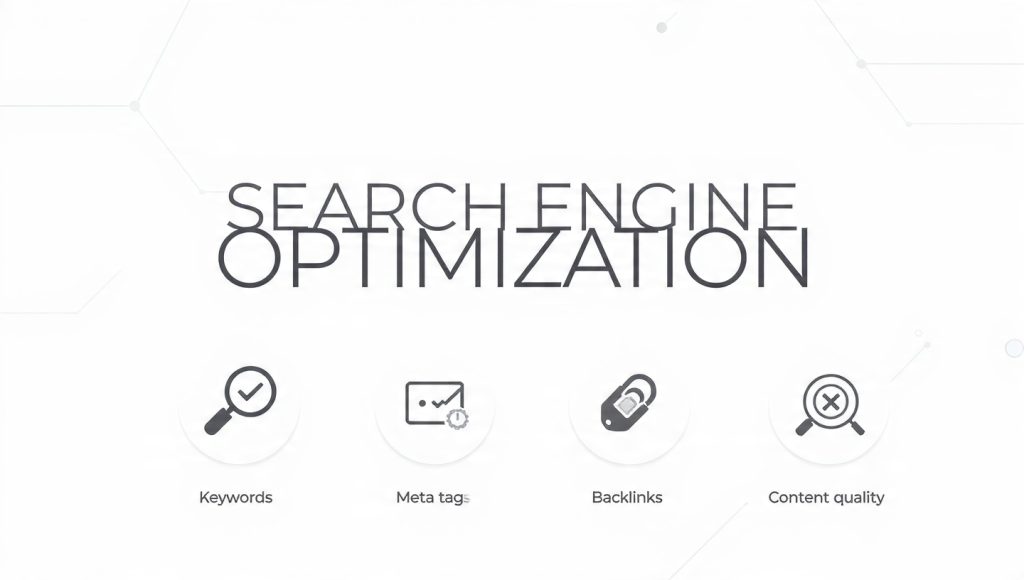
Content quality is also part of on-page SEO. Google’s algorithms prioritize content that demonstrates E-E-A-T: Experience, Expertise, Authoritativeness, and Trustworthiness . This means your content should genuinely help users and come from a place of real knowledge.
2. Off-Page SEO
Off-page SEO refers to actions taken outside your website that impact your rankings . The most important factor here is backlinks—links from other reputable websites to yours.
Google views backlinks as “votes of confidence.” When high-quality sites link to you, it signals that your content is trustworthy and authoritative .
Common off-page SEO activities include:
- Earning backlinks through great content
- Guest posting on relevant industry blogs
- Digital PR and outreach
- Social media engagement (indirect influence)
Important warning: Avoid “black hat” tactics like buying links or participating in link farms. These violate Google’s guidelines and can result in severe penalties, including removal from search results entirely .
3. Technical SEO
Technical SEO involves optimizing the behind-the-scenes aspects of your website to ensure search engines can crawl, index, and understand your content effectively .
Key technical elements include:
- Site speed—faster-loading pages rank better
- Mobile-friendliness—your site must work perfectly on phones
- Crawlability—ensuring search engines can access your content
- XML sitemaps—roadmaps that help search engines find your pages
- HTTPS/SSL security—essential for user trust and rankings
- Structured data (schema markup)—helping search engines understand your content and display rich results like star ratings or FAQs
Technical SEO is the foundation that supports everything else. If search engines can’t properly crawl and index your site, your on-page and off-page efforts won’t matter.
The Evolution of SEO: What’s New in 2026
SEO isn’t static. It evolves constantly as search engines update their algorithms and user behavior changes. Here’s what’s shaping SEO in 2026:
AI and Search Generative Experience
Google’s Search Generative Experience (SGE) and similar AI-powered features are changing how people search. Instead of just listing blue links, search engines now generate comprehensive answers directly in the results .
This has given rise to a new discipline: Generative Engine Optimization (GEO) . GEO optimizes content specifically for AI models so your brand gets mentioned in AI-generated responses—even if users never click through to your website .
Voice Search Optimization
With smart speakers and voice assistants everywhere, more people are using conversational queries . Optimizing for voice search means focusing on natural language, question-based keywords, and providing direct answers.
Core Web Vitals
Google continues to emphasize user experience through Core Web Vitals—specific metrics measuring loading performance, interactivity, and visual stability . Sites that deliver better experiences are rewarded with higher rankings.
Video SEO
Video content continues to explode. Optimizing videos for search—on YouTube and in general web search—has become essential for many businesses .
Common SEO Misconceptions
“SEO Guarantees #1 Rankings”
No legitimate SEO professional can guarantee the top spot. Search engine algorithms are too complex and constantly changing . What quality SEO can do is improve your visibility and rankings over time.
“SEO Is a One-Time Task”
SEO isn’t a set-it-and-forget-it activity. Search engines continuously update their algorithms, competitors adjust their strategies, and user behavior evolves . Effective SEO requires ongoing attention and adaptation .
“I Can Just Stuff My Pages with Keywords”
Keyword stuffing—loading pages with excessive keywords—actually hurts your rankings. Google’s algorithms are sophisticated enough to detect this manipulation, and they penalize sites that try it . Focus on natural, helpful content instead.
“Any Traffic Is Good Traffic”
Not all website visitors are valuable. Quality SEO focuses on attracting your target audience—people genuinely interested in what you offer and likely to become customers .
How to Get Started with SEO
If you’re new to SEO, the process can feel overwhelming. Here’s a simple roadmap to begin:
Step 1: Understand Your Audience
Before optimizing anything, know who you’re trying to reach. What questions do they have? What problems do they need solved? What words do they use when searching?
Step 2: Perform Keyword Research
Use tools like Google’s free Keyword Planner or beginner-friendly options like Ubersuggest to find terms your audience searches for. Focus on long-tail keywords—specific phrases with lower competition (like “best running shoes for women with flat feet” rather than just “shoes”) .
Step 3: Create Quality Content
Write content that genuinely helps people. Answer their questions thoroughly. Be the best answer on the internet for your chosen topics.
Step 4: Optimize Your Pages
Apply basic on-page SEO to your content: use your keyword in the title, headers, and naturally throughout the text. Write compelling meta descriptions. Optimize your images.
Step 5: Ensure Technical Basics
Use free tools like Google Search Console to monitor your site’s health. Check that your site loads quickly and works well on mobile devices. Submit a sitemap to Google.
Step 6: Build Your Reputation
Create content so good that other websites naturally want to link to it. Reach out to relevant sites for guest posting opportunities. Engage with your community.
Step 7: Monitor and Adjust
SEO takes time. Use free tools to track your progress. See what’s working and do more of that. See what isn’t and adjust.
Frequently Asked Questions
How long does SEO take to work?
SEO is a long-term strategy. Most websites take 6-12 months to see meaningful results . It depends on your competition, your industry, and how much effort you put in.
Can I do SEO myself?
Absolutely. Many small business owners and bloggers handle their own SEO, especially for basic on-page optimization . As you grow, you may eventually want to hire experts, but starting yourself is not only possible—it helps you understand your business better.
How much does SEO cost?
SEO costs vary widely:
- DIY: Your time and effort (and possibly some low-cost tools)
- Freelancers: $75-$150 per hour
- Agencies: $2,500-$10,000+ per month for comprehensive services
Is SEO better than paid advertising?
They serve different purposes. SEO builds long-term, sustainable traffic that continues even if you stop paying. Paid advertising generates immediate traffic but stops the moment you stop spending. Most successful businesses use both .
What’s the difference between SEO and GEO?
Traditional SEO optimizes for search engine result pages to drive website clicks. GEO (Generative Engine Optimization) optimizes for AI platforms (ChatGPT, Claude, AI Overviews) so your brand gets mentioned in AI responses—even if users never click through . You need both strategies in 2026 .
Start Your SEO Journey Today
Understanding what search engine optimization is—and isn’t—is the first step toward online visibility. SEO isn’t about tricking Google or gaming the system. It’s about creating a website that’s genuinely useful, easy to find, and trustworthy.
The fundamentals haven’t changed: create great content that helps people, make sure search engines can access it, and build a reputation that earns trust.
Start with the basics. Optimize one page at a time. Answer your customers’ questions thoroughly. Monitor your progress and keep learning.
Your customers are searching. Make sure they can find you.
 Previous Post
 Next Post