

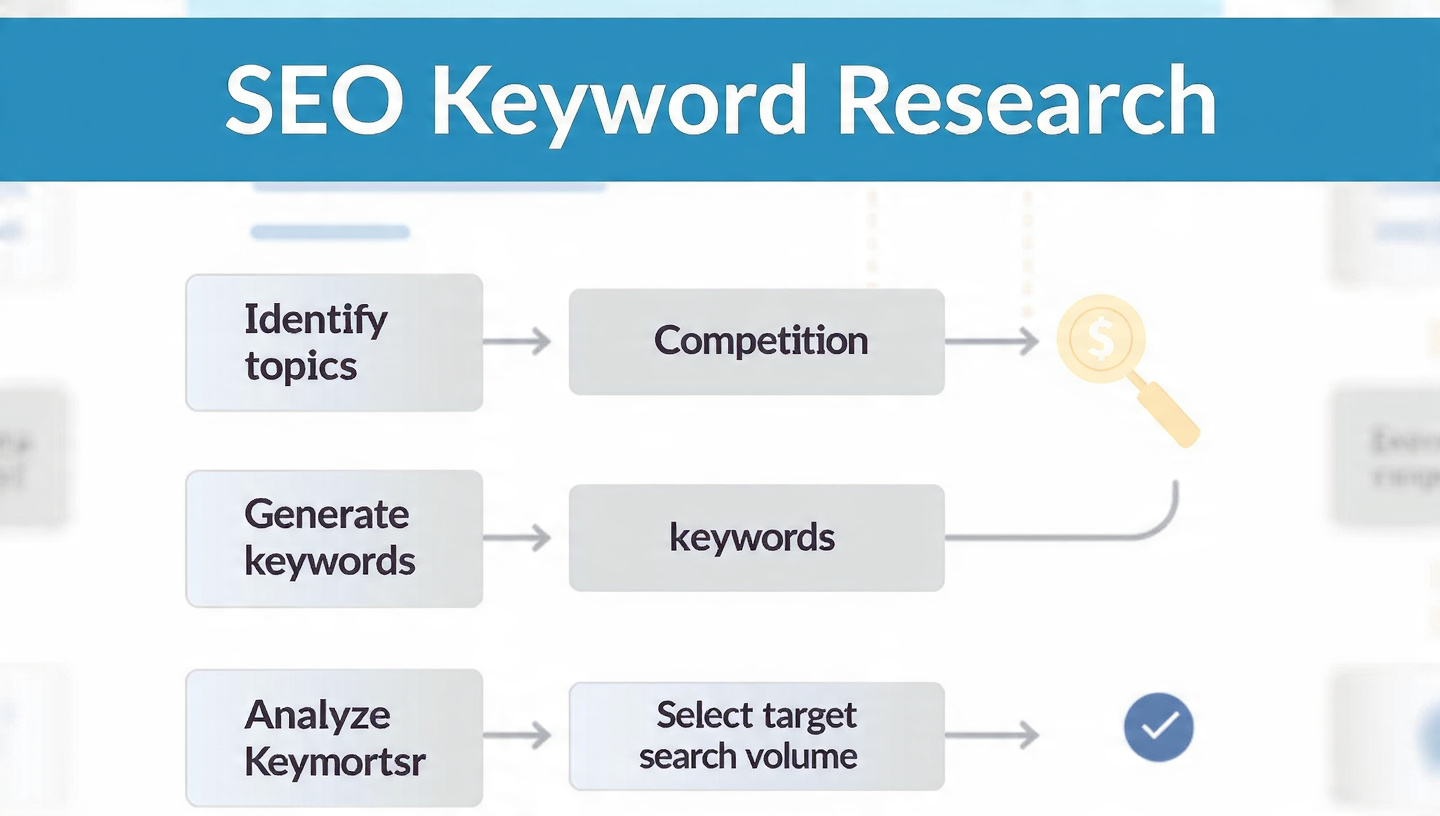
Imagine building a beautiful, informative website—and then realizing that nobody is searching for anything on it.
That’s what happens when you skip SEO keyword research.
Keywords are the bridge between what people are searching for and the content you create. They are the questions your audience asks, the problems they need solved, and the phrases they type into Google at 2 a.m. looking for answers.
Without keyword research, you’re creating content in the dark. With it, you’re building a roadmap straight to your ideal customers.
This guide will teach you everything you need to know about keyword research—from the fundamental concepts to advanced strategies for 2026. Whether you’re a complete beginner or a seasoned marketer looking to refresh your skills, you’ll find actionable steps to improve your SEO.

What Is SEO Keyword Research?
SEO keyword research is the process of discovering and analyzing the search terms that people enter into search engines, with the goal of using that data to inform your content strategy .
At its core, keyword research answers three essential questions:
- What is my target audience searching for?
- How many people are searching for it?
- How difficult will it be to rank for those terms?
Think of keywords as market research for the digital age. Just as a retailer studies which products customers want to buy, content creators study which topics people want to learn about .
Why Is Keyword Research Important?
Keyword research is the foundation of virtually every successful SEO campaign. Here’s why it matters:
Understanding Your Audience: Keyword research reveals the specific language your customers use. You might call it “digital marketing services,” but they might search for “help with Facebook ads.” Using their language makes your content more discoverable .
Identifying Demand: Before you spend hours creating content, keyword research confirms that people are actually interested in that topic. There’s no point writing the world’s best article about something nobody searches for .
Spotting Trends and Opportunities: Keyword data can reveal rising trends before they become mainstream, giving you a first-mover advantage in your niche .
Informing Content Strategy: Keyword research shows you what your audience cares about most, helping you prioritize topics that will actually drive traffic .
Supporting Other Marketing Channels: The insights from keyword research extend beyond SEO—they inform PPC campaigns, social media strategy, and product development .

Core Keyword Concepts
Before diving into the research process, you need to understand a few fundamental concepts.
Search Intent (The Most Important Concept)
Search intent (sometimes called user intent) is the “why” behind a search query. Understanding why someone is searching is more important than the specific words they use .
Google’s entire goal is to satisfy user intent. If your content doesn’t match what the searcher actually wants, you’ll never rank—no matter how well-optimized your page is.
There are four main types of search intent:
| Intent Type | Description | Example | Content Type |
|---|---|---|---|
| Informational | Searcher wants to learn something | “how to tie a tie” | Blog posts, guides, tutorials |
| Commercial Investigation | Searcher researching before buying | “best running shoes 2026” | Reviews, comparisons, best-of lists |
| Transactional | Searcher ready to buy | “buy Nike Air Max online” | Product pages, landing pages |
| Navigational | Searcher looking for specific website | “Facebook login” | Homepages, login pages |
Matching intent is non-negotiable. If someone searches “buy coffee maker” (transactional) and lands on your blog post “history of coffee” (informational), they’ll bounce immediately—and Google will notice .
Keyword Metrics
When evaluating keywords, SEO professionals look at three primary metrics:
Search Volume: How many people search for this term each month? Higher volume means more potential traffic, but usually means more competition .
Keyword Difficulty (KD) : An estimate of how hard it will be to rank for a given term, usually scored from 0-100. Higher scores mean more competition from established, authoritative sites .
Cost-Per-Click (CPC) : What advertisers pay for this term in Google Ads. High CPC usually indicates commercial intent—searchers are ready to spend money .
Short-Tail vs. Long-Tail Keywords
Keywords exist on a spectrum from broad to specific:
| Short-Tail (Head Terms) | Mid-Tail | Long-Tail | |
|---|---|---|---|
| Example | “shoes” | “running shoes” | “best running shoes for women with flat feet” |
| Search Volume | Very high | Medium | Lower |
| Competition | Extremely high | High | Lower |
| Intent | Unclear | Clearer | Very specific |
| Conversion Potential | Low | Medium | High |
Long-tail keywords are the sweet spot for most content creators. They have lower competition and searchers know exactly what they want, making them more likely to convert .
The Keyword Research Process: Step by Step
Now let’s walk through the actual process of finding and selecting keywords.
Step 1: Brainstorm Seed Keywords
Start with the obvious. If you were your ideal customer, what would you type into Google?
Ask yourself:
- What problems does my product/service solve?
- What questions do customers frequently ask me?
- What terms would I search for if I needed what I offer?
Create a list of 10-20 seed keywords—broad terms that define your core topics. For a fitness blog, seeds might include: “workout routines,” “healthy recipes,” “weight loss tips,” “muscle building.”
Step 2: Use Keyword Research Tools
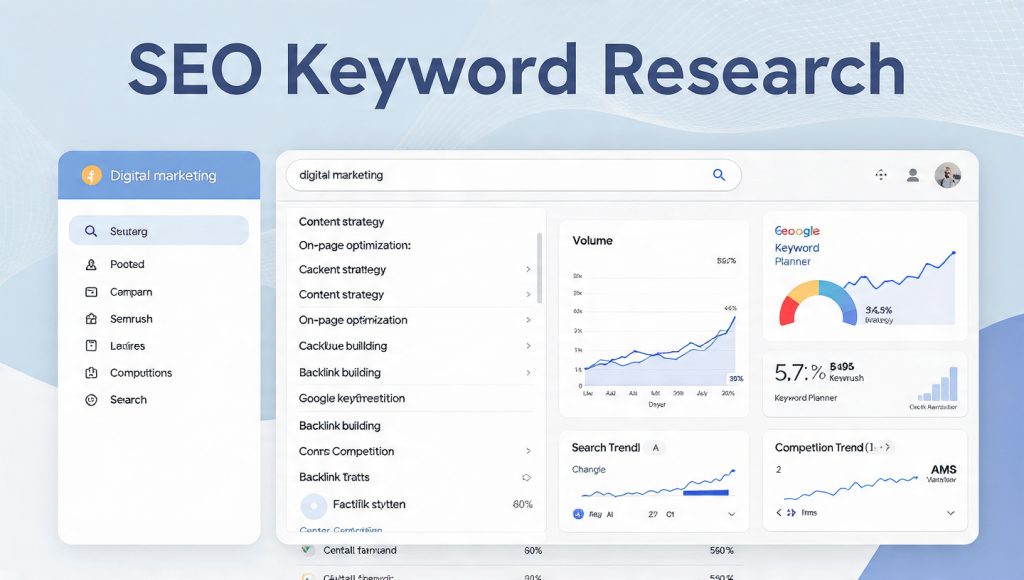
Take your seed keywords and expand them using research tools. These tools show you actual search data and suggest related terms you might not have considered.
Free options:
- Google Keyword Planner (requires Google Ads account, but free to use)
- Google Autocomplete (start typing and see suggestions)
- “People Also Ask” boxes in Google results
- Related searches at the bottom of Google’s results page
- AnswerThePublic (visualizes questions people ask)
- Ubersuggest (limited free searches)
Paid tools worth considering:
- Semrush – Comprehensive keyword database and competitive analysis
- Ahrefs – Excellent for keyword difficulty and click metrics
- Mangools (KWFinder) – Beginner-friendly with intuitive interface
- SE Ranking – Affordable alternative with solid keyword data
For each seed keyword, these tools will generate hundreds of related terms along with search volume, trend data, and difficulty scores .
Step 3: Analyze Search Intent
For each potential keyword, ask: What is the searcher actually looking for?
The best way to determine intent is to look at the current top-ranking pages. Search for your keyword and analyze the results:
- Are the top results blog posts or product pages?
- Are they long-form guides or short answers?
- Do they include buying options or educational content?
If the top 10 results are all buying guides, Google has decided this is a commercial-intent query. Creating a product page might work; creating a general informational post probably won’t .
Step 4: Evaluate Keyword Metrics
Now it’s time to prioritize. Create a spreadsheet with columns for:
- Keyword
- Search volume
- Keyword difficulty
- Intent
- Notes (why this keyword matters)
Look for keywords that balance decent search volume with manageable competition. For a new website, targeting keywords with difficulty scores under 30 is usually wise. As your site gains authority, you can target more competitive terms .
Step 5: Identify Content Opportunities
Beyond individual keywords, look for patterns and topic clusters. If you find multiple related keywords, you might have the foundation for a comprehensive pillar page or topic cluster .
For example, if you find:
- “how to start a podcast”
- “best podcast equipment for beginners”
- “how to record a podcast at home”
- “podcast editing software”
These could all live within a comprehensive guide to podcasting for beginners, with individual sections targeting each specific query.
Step 6: Study Your Competitors
Competitor research reveals gaps in your own strategy. Enter a competitor’s domain into a tool like Semrush or Ahrefs and see what keywords they rank for .
Ask yourself:
- Which of their keywords should I also target?
- Are there keywords they’re missing that I could capture?
- What content formats are working for them?
- Can I create something better on the same topics?
Competitor analysis isn’t about copying—it’s about finding opportunities they’ve overlooked .
Step 7: Map Keywords to Content
Finally, organize your keywords into a content plan. Group related terms and decide what type of content each deserves:
- Informational keywords → Blog posts, guides, tutorials
- Commercial keywords → Comparison posts, reviews, best-of lists
- Transactional keywords → Product pages, landing pages
- Navigational keywords → Optimize existing pages for branded terms
Create a content calendar that systematically targets your prioritized keywords over time .

Advanced Keyword Research Strategies for 2026
Once you’ve mastered the basics, these advanced strategies will give you an edge.
AI-Powered Keyword Discovery
In 2026, AI tools have transformed keyword research. Tools like ChatGPT, Claude, and specialized SEO platforms can generate extensive keyword lists based on seed terms and identify semantic relationships that humans might miss .
How to use AI for keyword research:
- Generate hundreds of long-tail variations from a single seed
- Identify question-based keywords (“why,” “how,” “what,” “when”)
- Cluster related keywords into topic groups
- Analyze sentiment and intent patterns
Remember: AI is a starting point, not a replacement for human judgment. Always validate AI suggestions with actual search data .
SERP Feature Targeting
Modern search results include various features beyond the traditional blue links. Targeting these features can dramatically increase your visibility.
SERP features to target:
| Feature | Description | Best For |
|---|---|---|
| Featured Snippets | Direct answers at the top of results | Question-based keywords, definitions |
| “People Also Ask” | Related question dropdowns | Informational content |
| Video Carousels | Video results | How-to content, demonstrations |
| Local Packs | Map results with local businesses | Local keywords (“near me”) |
| Image Packs | Image results | Visual topics, products |
To target featured snippets, structure your content to directly answer questions concisely, then provide deeper context .
Search Generative Experience (SGE) Optimization
Google’s Search Generative Experience uses AI to generate comprehensive answers directly in search results. This changes keyword research because users may get answers without clicking through to websites .
Optimizing for SGE:
- Focus on creating authoritative, well-structured content
- Use clear headings and formatting that AI can easily parse
- Include data, statistics, and citations that add credibility
- Aim to be the source AI pulls from, even if clicks decrease
YouTube and Video Keyword Research
YouTube is the world’s second-largest search engine. For many topics, video content is essential .
YouTube keyword research tips:
- Use YouTube’s autocomplete for video-specific suggestions
- Analyze top-performing videos in your niche
- Look for question-based keywords that work well in video format
- Consider creating video versions of your top blog content
Local Keyword Research
For businesses serving specific geographic areas, local keywords are essential.
Local research strategies:
- Include location modifiers (“plumber in Austin,” “Chicago pizza”)
- Target “near me” searches (even without the word, Google localizes results)
- Optimize for Google Business Profile categories
- Research local landmarks and neighborhoods

Keyword Research Tools Comparison
Here’s how the major keyword research tools stack up:
| Tool | Best For | Free Version | Starting Price | Key Strength |
|---|---|---|---|---|
| Semrush | All-in-one SEO | Limited | $139.95/month | Largest keyword database, competitive analysis |
| Ahrefs | Backlink + keyword | No | $29/month | Accurate difficulty scores, click metrics |
| Mangools | Beginners | 10 searches/day | $29.90/month | Easiest interface, visual appeal |
| SE Ranking | Budget-friendly | 10 free checks | $52/month | Best value for features |
| Ubersuggest | Solopreneurs | 3 searches/day | $29/month | Lifetime deal available |
| Google Keyword Planner | PPC + basic research | Free | Free | Direct Google data |
| AnswerThePublic | Question discovery | Limited | $99/month | Visual question clusters |
| SpyFu | Competitor focus | Limited | $39/month | 18+ years of historical data |
Common Keyword Research Mistakes
Avoid these pitfalls that trip up beginners (and even experienced SEOs):
Targeting Keywords with No Intent
High-volume keywords are tempting, but if they lack clear intent, they rarely convert. “Coffee” might have huge volume, but what does the searcher actually want? History? Recipes? Buying beans? Match your content to clear intent .
Ignoring Long-Tail Opportunities
Going after “best running shoes” (high competition) instead of “best running shoes for marathon training with flat feet” (lower competition, higher intent) is a common mistake. Long-tail keywords build authority over time .
Keyword Cannibalization
This happens when multiple pages on your site target the same keyword. Google gets confused about which page to rank, and neither performs as well as they could .
Fix it: Ensure each keyword targets one primary page, and use internal linking to reinforce which page matters most .
Focusing Only on Volume
High search volume doesn’t always mean high value. A keyword with 100 searches that converts at 10% might be worth more than a keyword with 1,000 searches that converts at 0.5%. Consider business value, not just traffic potential .
Ignoring SERP Features
The way results display affects how you should optimize. If the top results are all videos, creating a text post might be an uphill battle. If there’s a featured snippet opportunity, structure your content to capture it .

How to Turn Keywords into Content
Finding keywords is only half the battle. Here’s how to use them effectively:
Create Comprehensive Content
Don’t just write 500 words targeting a single keyword. Create in-depth content that naturally incorporates related terms and fully satisfies user intent .
Use Keywords Naturally
Gone are the days of keyword stuffing. Use your target keyword in:
- The page title (H1)
- The meta description
- The first 100 words of content
- One H2 subheading (if natural)
- Image ALT text (if relevant)
Beyond that, write naturally for humans. Include synonyms and related terms (sometimes called LSI keywords) that help search engines understand context .
Structure for Readability
Use clear headings, short paragraphs, bullet points, and images to make your content easy to consume. Good user experience signals quality to search engines .
Monitor and Update
Keyword rankings change. Competitors create new content. Search intent evolves. Regularly review your keyword performance and update content to maintain relevance .
Frequently Asked Questions
How many keywords should I target per page?
Focus on one primary keyword per page, plus several related secondary keywords. The primary keyword defines the page’s main topic; secondary keywords provide context and capture variations .
How long does keyword research take?
Initial research for a new site might take several hours. Ongoing research (checking for new opportunities, monitoring competitors) becomes part of your regular routine—perhaps a few hours per month.
Can I rank for keywords without backlinks?
For low-competition keywords, yes—especially if you create excellent content that perfectly matches intent. For competitive terms, backlinks are usually necessary. This is why starting with long-tail keywords makes sense for new sites .
What’s the difference between keywords and topics?
Keywords are specific search queries. Topics are broader subject areas. Modern SEO thinks in topics and clusters: a topic might have dozens of related keywords. Creating comprehensive topic coverage signals authority to search engines .
How often should I do keyword research?
Regularly. Set aside time monthly or quarterly to:
- Find new keyword opportunities
- Check what competitors are targeting
- Identify content that needs updating
- Spot emerging trends in your industry
Start Your Keyword Research Today
Keyword research is the foundation of everything in SEO. It ensures you’re creating content people actually want, targeting terms you can realistically rank for, and building a strategy that drives real business results.
Start simple. Brainstorm your seed keywords. Use free tools to expand your list. Analyze intent and competition. Then create one piece of great content targeting your best opportunity.
The path to better rankings begins with a single keyword.
Ready to find your first high-value keywords? Pick a tool from this guide and start exploring what your audience is searching for today.
 Previous Post