

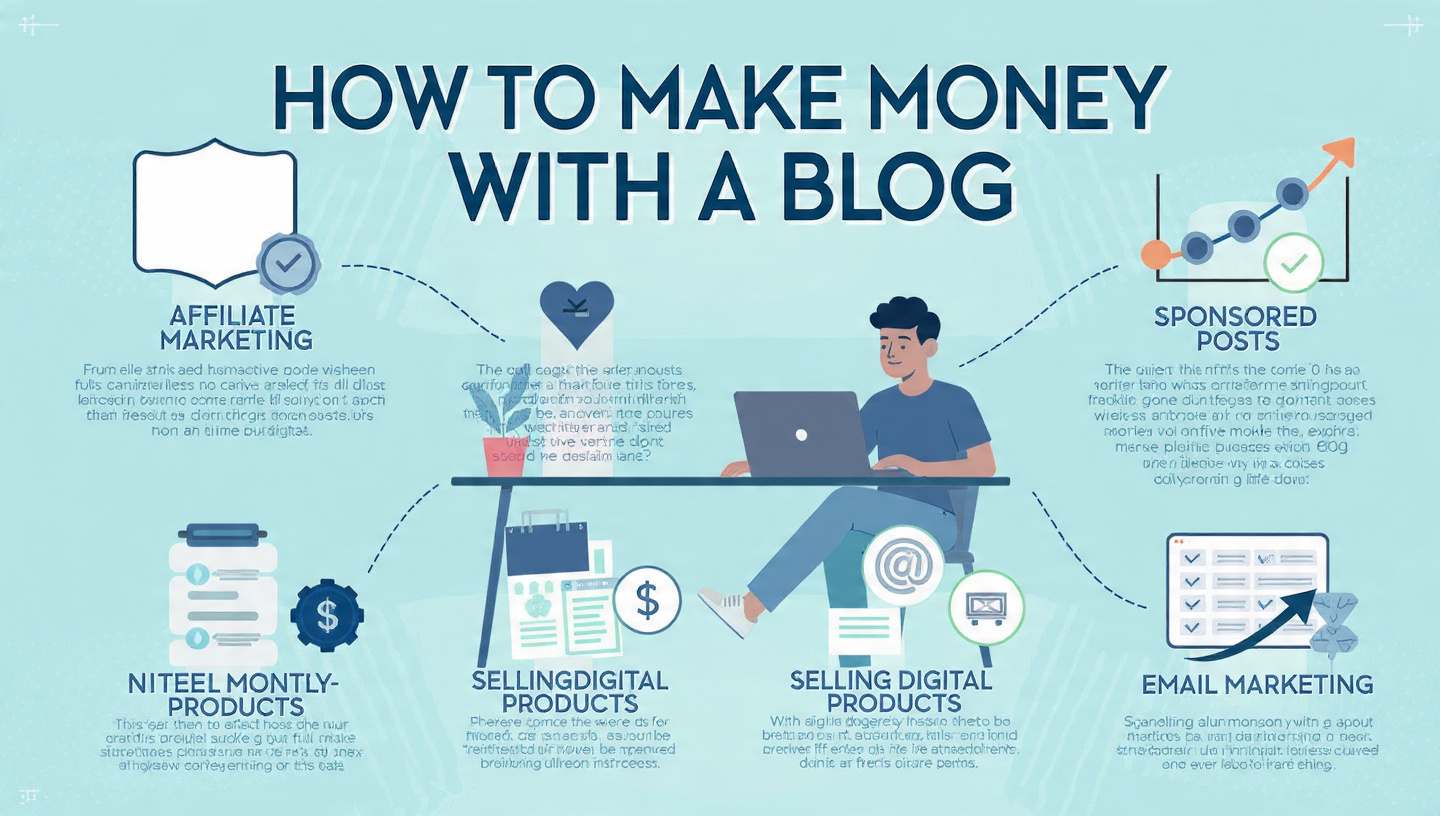
You’ve got something to say. Ideas, stories, expertise—they’re all swirling in your head, waiting to be shared.
But beyond the creative fulfillment, there’s another question: Can you actually make money doing this?
The answer is a resounding yes—but not by accident. In 2026, blogging has evolved far beyond a personal diary. It’s a legitimate business model that, when built strategically, can generate significant income . According to a 2025 survey, bloggers who earn over $2,000 per month share key habits: they blog consistently, build email lists, diversify income streams, and invest in SEO and content marketing .
This guide walks you through exactly how to make money with a blog—from laying the foundation to diversifying revenue streams and scaling your success.
The Blogging Business Model: How It Really Works
First, let’s clear up a common misconception: a blog itself doesn’t make money. It’s what the blog enables that drives income :
- Audience attention → Valuable traffic
- Trust and expertise → Influence and brand authority
- Content → Monetized via various income streams
Here’s the simplified version of the blogging business model :
- Create valuable content to attract readers
- Grow traffic through SEO, social media, and email
- Monetize that traffic via ads, affiliate links, sponsored content, products, or services
Think of your blog as the hub of a content marketing machine. You produce free, valuable content to build trust, then offer something worth paying for .
Step 1: Build a Foundation That’s Built to Earn
Before you make a single dollar, you must build a platform that is professional, trustworthy, and optimized for conversions. Your audience will not spend money on a site that looks amateurish or performs poorly .
Choose a Profitable Niche
Your niche is the specific topic you will write about. This is the most important decision you will make. You must balance three things :
- Your Passion: You must have a genuine interest. You’ll write hundreds of articles.
- Audience Demand: Are people actively searching for this topic? Use Google Trends or keyword tools to check.
- Profitability: Are there products, services, or ads related to this niche? If no one spends money here, it’s hard to earn.
A profitable blog niche shares three characteristics: sustained audience demand, multiple monetization paths, and room for a new voice to stand out .
Most profitable blog niches in 2026 :
- Personal finance and investing
- Health, fitness, and wellness
- Technology, software, and gadgets
- Food and recipes
- Travel and lifestyle
- Parenting and family
- Digital marketing and online business
- WordPress and website development
Pro tip: Micro-focused topics consistently outperform broad categories. Instead of “health,” try “vegan meal prep for busy college students.” Instead of “travel,” try “solo travel in Southeast Asia on a budget.” You’ll face less competition and attract a more dedicated audience .
Set Up Your Blog
For serious bloggers, WordPress.org remains the top choice. It gives you complete ownership, unlimited customization, and the ability to scale . You’ll need:
- A domain name (yourblogname.com)
- Reliable hosting (look for speed, uptime, and support)
- A professional theme (Astra, Kadence, or GeneratePress are great options)
Your blog’s design impacts trust and conversions. A clean, modern, mobile-responsive design builds instant credibility .
Step 2: Drive Traffic to Your Blog
You must have an audience before you can monetize. Focus relentlessly on driving traffic .
Master SEO (Search Engine Optimization)
SEO is the long-term engine for blog traffic. When you rank in Google, traffic keeps coming .
Keyword research basics: Find terms your audience searches for, especially those with “buyer intent” like “best,” “review,” “vs,” and “coupon” . Target long-tail keywords with lower competition.
On-page SEO essentials: Include your target keyword in titles, headings, and naturally in content. Write compelling meta descriptions. Use descriptive alt text for images. Internal link to your other relevant posts .
Build an Email List
Your email list is one of your most valuable assets for long-term income . Email subscribers are your most engaged readers—they’ve invited you into their inbox.
- Free checklist related to your niche
- E-book or guide
- Email course (5-7 lessons)
- Exclusive resource or template
Leverage Other Traffic Channels
- Pinterest: Works like a visual search engine. Create eye-catching Pins linking to your blog posts .
- Social media: Share your content where your audience hangs out.
- Quora or LinkedIn: Answer questions and link back to relevant posts .
Step 3: Monetize Your Blog (7 Proven Strategies)
Smart bloggers never rely on just one income stream. They build a “monetization stack” . Here are the seven most effective methods.
Method 1: Display Advertising
This is the most common monetization method. You place ads on your blog and get paid when visitors see or click them .
- Getting started: Google AdSense is open to almost any blogger. Payouts are low, but it’s an easy first step .
- Leveling up: Premium networks like Mediavine and Raptive (formerly AdThrive) have higher traffic requirements (e.g., 50,000+ monthly sessions) but pay 5x to 10x higher rates .
Example: A food blog with 100,000 monthly pageviews can earn $1,000–$3,000/month from ads alone .
Method 2: Affiliate Marketing
Affiliate marketing is a favorite model for new bloggers. You earn a commission when a reader purchases a product you recommend .
How it works: You join an affiliate program, get a unique tracking link, and place it in your blog posts. When someone clicks and buys, you earn a percentage .
Top-performing affiliate niches :
- Web hosting (commissions up to $150 per sale)
- SEO and marketing tools (Ahrefs, SEMrush, ConvertKit)
- Online courses and coaching programs
- Niche-specific tools and gear
- Promote what you actually use (authenticity matters)
- Disclose your affiliate relationships (legally required and builds trust)
- Create comparison posts and “best of” lists
- Help readers make decisions—don’t just “sell”
Example: A productivity blog might earn $50 per sale recommending a $500 course .
Method 3: Sponsored Posts
Brands pay you to write content featuring their products .
Typical payouts: $100–$1,000 per post for smaller blogs; up to $5,000+ for influencers with larger audiences .
Rates depend on your traffic, domain authority, and niche influence .
Method 4: Sell Digital Products
Digital products offer the highest profit margins because they cost little to produce after the initial creation. There’s no inventory, shipping, or manufacturing .
- E-books (e.g., “30-Day Minimalist Challenge” for a lifestyle blog)
- Printable planners, checklists, or worksheets
- Premium courses (video or text-based)
- Design assets (Canva templates, social media kits)
- Software tools or Notion dashboards
The key: Your product must solve a specific problem your audience already has .
Example: A personal finance blog could sell a $29 budgeting spreadsheet and make $3,000/month with just 100 sales .
Method 5: Offer Services or Consulting
If you’ve built authority in your niche, your time is valuable. One-on-one services allow you to charge premium rates .
- Career development: Resume reviews, interview coaching ($100–$200/hour)
- Personal finance: Budget audits, debt payoff planning ($150+/session)
- Content marketing: Blog strategy sessions, SEO audits ($200–$500/project)
- Fitness: Nutrition coaching, habit tracking ($80–$150/month)
Use blog content to demonstrate your expertise—your “How I Paid Off $30K in Debt” post becomes proof you can help others do the same .
Method 6: Memberships and Paid Communities
A membership site turns occasional visitors into recurring revenue. Subscriptions provide predictable income .
- Content vault: Premium articles, video tutorials, downloadable resources ($10–$30/month)
- Community access: Private forum or Slack group with monthly Q&As ($15–$50/month)
- Coaching loop: Group coaching with live calls and progress tracking ($50–$100/month)
Example: Even just 100 fans paying $5/month creates a $500/month base income .
Method 7: Sell Physical Products or Merchandise
If you have a strong brand, you can create and sell T-shirts, mugs, or niche-based products via Shopify, Etsy, or print-on-demand services .
Print-on-demand is a low-investment option—products ship directly from suppliers to customers, so you don’t handle inventory .
How Much Money Can You Really Make?
Here’s a realistic timeline for blogging income :
| Timeframe | Typical Earnings | Notes |
|---|---|---|
| First 6 months | $0 – $500 | Building foundation, learning SEO |
| 6-12 months | $500 – $2,000 | First posts ranking, traffic growing |
| 1-2 years | $2,000 – $5,000 | Established authority, multiple income streams |
| 2+ years | $5,000 – $10,000+ | Scaling content, optimizing conversions |
Top performers in competitive niches earn six figures or more annually. But for beginners, focus on learning and consistent effort—the money follows .
Case Study: From Blog to Six-Figure Business
Jamie Rivera ran a small personal finance blog focused on side hustles. After two years, she earned only $300/month from AdSense. She shifted focus :
- Created a $27 e-book: “Side Hustle Starter Kit”
- Launched a $197/year membership with job board access and resume templates
- Began promoting high-commission tools like QuickBooks and Shopify
- Offered 1:1 coaching at $150/hour for freelancers
Within 18 months, her blog generated over $8,000/month—nearly 30x her previous income—with less than 50,000 monthly pageviews. Her secret? She stopped chasing traffic and started solving problems .
Common Mistakes That Slow Down Blogging Income
Many bloggers struggle—not because blogging doesn’t work, but because of avoidable mistakes :
- Blogging without a monetization plan. Write with clear income goals from the start.
- Ignoring keyword research. Publishing without targeting search demand means no organic traffic.
- Over-focusing on design. Design matters, but content creation and SEO move the needle.
- No email list. Not capturing emails means losing future buyers.
- Inconsistent publishing. Posting once a month isn’t enough. Aim for 1-2 SEO-optimized posts weekly in your first year.
- Spamming affiliate links without value. Readers buy when you recommend with honesty and authority.
Your 90-Day Action Plan
Month 1: Foundation
- Choose a profitable niche (validate for demand and monetization)
- Set up WordPress hosting and install a professional theme
- Write and publish 5 cornerstone articles
- Set up Google Analytics and Search Console
- Create a lead magnet and email signup form
Month 2: Traffic and Content
- Publish 8-10 more articles (targeting buyer intent keywords)
- Promote content on Pinterest, social media, or relevant communities
- Join 2-3 affiliate programs in your niche
- Add affiliate links naturally to existing content
Month 3: Monetization
- Apply to premium ad networks if you meet traffic requirements
- Create one simple digital product (e-book, template, checklist)
- Offer 3 coaching spots at a discounted rate for testimonials
- Analyze what’s working and double down on top earners
Frequently Asked Questions
How long does it take to make money from a blog?
Beginner bloggers may see first earnings within 3 to 6 months if they focus on SEO and affiliate content. More significant income ($500–$1,000/month) often comes after 12 months of consistent effort .
Do I need a lot of traffic to make money?
No. A smaller, highly engaged audience often converts better than a large, passive one. One hundred loyal readers might buy your $50 course, while ten thousand casual visitors may not click a single ad .
What’s the fastest way to make money blogging?
- Choose a profitable niche (finance, software, health)
- Focus on affiliate marketing + freelance services
- Create SEO content targeting buyer intent keywords
- Drive traffic via Pinterest, Quora, or LinkedIn
- Collect emails from day one and nurture your list
Do I need to be an expert?
You need to know more than your reader. Share your experiences, research thoroughly, and be honest about what you know. Authenticity builds trust, and trust drives conversions .
Can I make money blogging part-time?
Absolutely. Most successful bloggers started part-time while working full-time jobs. Consistency matters more than hours .
Start Making Money with Your Blog Today
Blogging in 2026 isn’t about writing random posts and hoping for the best. It’s a strategic business built on valuable content, audience trust, and diversified income streams.
The bloggers who thrive long-term treat their platform as a business—not just a publishing outlet. By creating products, offering services, and building relationships, you shift from earning pennies per click to receiving real value for the solutions you provide .
The tools and opportunities have never been more accessible. Pick one strategy, start small, and build momentum.
Your blog isn’t just a website—it’s a revenue-generating asset waiting to be unlocked.
 Previous Post