
So, you’ve done it. You’ve finally launched your blog.
Maybe you’ve been dreaming about this for months. Maybe you’ve been writing in the dark hours before work, or during nap times, or while the rest of the world was asleep. You’ve built something from nothing—a little corner of the internet that’s entirely yours. And now, you’re looking at your analytics, watching those visitor numbers tick up, and thinking:
“Okay… how do I actually turn this into money?”
First of all, take a moment to celebrate. Seriously. Stop reading for ten seconds and just appreciate what you’ve accomplished. Starting a blog is hard. Keeping it going is even harder. You’re already ahead of 90% of people who never get past the “I should start a blog” stage.
Now, let’s talk about the exciting, confusing, slightly overwhelming world of ad networks.
If you’ve done any research at all, you’ve probably seen two names pop up over and over again: Google AdSense and Ezoic. They’re everywhere. Every blogger seems to have a strong opinion about which one is better, which one pays more, and which one will make you want to pull your hair out during setup.
I’m here to give you the honest, unfiltered truth. No tech jargon that makes your head spin. No “get rich quick” promises. Just real talk from someone who’s been where you are and wants to help you make the smartest decision for YOUR unique blog.
Grab a cup of coffee (or tea, or whatever fuels your creativity), get comfortable, and let’s dive deep into this together.
The Big Question: Why Should You Even Care About Ad Networks?
Before we pit AdSense and Ezoic against each other like it’s a boxing match, let’s step back for a moment.
Ads are just one piece of your blogging income puzzle. They’re not the only way to make money, and honestly, they shouldn’t be your only way. A healthy, resilient blog has multiple income streams—affiliate marketing, digital products, coaching, sponsored posts, and yes, display ads.
But display ads are special. Why? Because they’re passive.
Once you set them up properly, they just… work. Every time someone visits your blog, you earn a tiny bit of money. It’s like having a little vending machine on your website. You don’t have to sell anything. You don’t have to convince anyone. You just need people to show up, and the ads do their thing.
That’s why choosing the right ad network matters so much. A bad choice could mean leaving hundreds (or even thousands) of dollars on the table. A good choice could mean turning your blog from a fun hobby into a legitimate side income that actually pays bills.
So let’s make sure you make the right choice from the start.
The Most Important Metric You Need to Understand
Okay, I need to teach you something before we go any further. Don’t worry—it’s not complicated, and once you get it, everything about ad earnings will make so much more sense.
You’re going to hear the term RPM everywhere. It stands for Revenue Per Mille, which is just a fancy way of saying “revenue per 1,000 pageviews.”
Think of RPM like your blog’s “hourly rate.” If you’re earning $5 RPM, that means for every 1,000 people who visit your site, you make $5. If you’re earning $20 RPM, that means you make $20 for every 1,000 visitors.
Here’s why this matters: your traffic number alone doesn’t tell you how much money you’ll make. Two blogs with exactly 10,000 monthly visitors could have wildly different earnings. One might make $50 a month. The other might make $500. The difference is their RPM.
So when we talk about which ad network “pays more,” what we’re really asking is: which network gives you a higher RPM?
And the short answer is: Ezoic typically offers higher RPMs than AdSense.
But—and this is a big “but”—there’s so much more to the story. RPM isn’t everything. Let me explain.
Google AdSense: The Friendly Giant
Imagine AdSense as that reliable, trustworthy friend who always shows up on time, never causes drama, and gives you solid advice. They might not be the most exciting person in the room, but you know exactly what you’re getting with them.
What Is AdSense, Really?
Google AdSense is the granddaddy of display advertising. It’s been around since 2003, and it’s literally the reason millions of bloggers have been able to turn their websites into businesses. Google created it to help website owners monetize their content while giving advertisers a massive network to reach audiences.
When you join AdSense, you’re essentially renting out space on your website to Google. Google finds advertisers who want to show ads to your audience, serves those ads on your site, and takes a cut before paying you the rest.
The beauty of AdSense is its simplicity. Google does all the heavy lifting. They decide which ads to show, where to show them, and how much to charge advertisers. You just sit back and watch the pennies roll in.
The Good Stuff About AdSense (And There’s a Lot of It)
1. It’s ridiculously easy to set up
I’m not kidding. If you can copy and paste, you can set up AdSense. You sign up, get approved (more on that in a minute), generate a small piece of code, paste it into your website, and boom—ads start appearing. No complicated configuration. No technical headaches. It takes maybe 15 minutes.
For a new blogger who’s still figuring out how WordPress works or what a “plugin” even is, this is priceless. You don’t want to spend hours wrestling with technical settings when you could be writing your next amazing post.
2. No traffic requirements
This is huge for new blogs. AdSense doesn’t care if you have 10 visitors a month or 10 million. You can apply from day one. Now, getting approved with zero traffic is tricky (more on that later), but there’s no minimum threshold you have to hit before you can even try.
3. It’s Google, so it’s trusted
There’s something comforting about working with the biggest company on the internet. You know they’ll pay you on time (well, mostly on time). You know their technology works. You know they’re not going to disappear overnight and take your earnings with them.
4. The ads are actually relevant
Google’s algorithm is scary smart. It looks at your content, understands what your readers are interested in, and serves ads that are genuinely relevant to them. This means higher click-through rates and happier visitors (well, as happy as anyone can be about seeing ads).
5. It’s a great learning tool
Think of AdSense as ad management 101. It teaches you the basics—how ads look on your site, how your audience interacts with them, what kind of revenue you can expect. It’s a low-stakes way to learn before you move on to more advanced networks.
The Not-So-Good Stuff About AdSense (Let’s Be Honest)
1. The pay is… modest
Here’s the thing about AdSense: it’s the entry-level job. It pays the least of all the major ad networks. While Ezoic might pay you $15–$25 RPM, AdSense typically pays more like $1–$10 RPM.
For a new blog with 5,000 monthly visitors, that could mean the difference between earning $25 a month and earning $75 a month. Over a year, that’s $300 versus $900. And as your traffic grows, that gap gets even wider.
2. The $100 payment threshold
This one stings for new bloggers. AdSense won’t pay you until you’ve earned at least $100. If you’re making $20 a month (which is realistic for a brand new site), that means waiting five months to see any money. Five months is a long time to wait, and it can feel discouraging when you’re just starting out.
3. Strict approval process
AdSense has a reputation for being picky. They want to see quality content, a professional-looking site, and some evidence that you’re serious about blogging. Many new bloggers get rejected on their first try. It’s not personal—Google just has high standards to protect their advertisers.
4. Limited control
You don’t get much say in what ads appear or where they’re placed. Google decides everything. If you want to optimize your ad placement for maximum earnings, you’re mostly out of luck. You get what you get.
5. No real support
Try contacting Google support sometime. I’ll wait. 🕐
Unless you’re a massive publisher, you’re pretty much on your own with AdSense. There are forums and help articles, but if you have a specific problem, good luck getting a human to help you.
Ezoic: The Smart, Ambitious Upstart
Now let’s talk about Ezoic. If AdSense is the friendly, reliable friend, Ezoic is the ambitious overachiever who’s always starting new projects, reading self-improvement books, and pushing themselves to do better. They’re a little intense sometimes, but you can’t deny the results.
What Is Ezoic, Exactly?
Ezoic is a Google Certified Publishing Partner. That’s a fancy way of saying they work directly with Google’s ad exchange, but they’re not owned by Google. They’re an independent company that’s built their own technology to help publishers make more money from their ads.
Here’s what makes Ezoic different: instead of just showing Google ads (like AdSense does), Ezoic connects your site to multiple ad exchanges simultaneously. They use something called “header bidding,” which is just a technical term for “let’s get multiple advertisers to compete for your ad space in real-time.”
When advertisers compete, prices go up. And when prices go up, you make more money.
Ezoic also uses artificial intelligence to test different ad layouts, sizes, and placements on your site. It figures out exactly which combination makes the most money for your specific audience. No two sites are the same, so having AI do this work is incredibly valuable.
The Good Stuff About Ezoic (And There’s a Lot)
1. Higher RPMs, plain and simple
This is why most people switch. Ezoic consistently pays more than AdSense—often 20-60% more. For many publishers, the difference is massive. We’re talking $10–$15 RPM instead of $3–$5 RPM.
Let me give you a concrete example. Say you have a blog with 25,000 monthly pageviews:
- With AdSense at $5 RPM, you’d earn $125/month.
- With Ezoic at $15 RPM, you’d earn $375/month.
That’s $250 more every single month. Over a year, that’s $3,000. For a new blogger, that’s not pocket change—that’s money that could pay for hosting, tools, courses, or even help with bills.
2. Lower payment threshold
Ezoic pays you once you reach just $20. That’s five times lower than AdSense’s $100 threshold. For a new blogger earning small amounts, this makes a huge difference. You’ll see that first payment much sooner, which is incredibly motivating.
3. No traffic minimum anymore
Ezoic used to require 10,000 monthly visitors, which put it out of reach for many new bloggers. But they’ve changed that. Through their “Access Now” program, you can join even with modest traffic. This levels the playing field beautifully.
4. Built-in site speed tools
Ezoic has a tool called LEAP that helps with Core Web Vitals—those website speed metrics that Google cares so much about. Faster sites rank better in search results, so this is actually valuable for your SEO. It’s like getting a free site speed consultant with your ad network.
5. You have control
Ezoic gives you much more control over where ads appear. You can set rules about ad density, choose specific placements, and decide how aggressive or conservative you want to be with your ad strategy.
6. Real support
Ezoic has actual humans you can contact. They have support teams, account managers for bigger publishers, and a community of users who help each other out. This is a breath of fresh air compared to AdSense’s “figure it out yourself” approach.
The Not-So-Good Stuff About Ezoic (Let’s Be Real)
1. The setup is more complex
This is the biggest hurdle. Instead of just pasting a code snippet, integrating Ezoic usually involves changing your DNS settings or using Cloudflare. If you’re not technically savvy, this can be intimidating.
You might need to learn about nameservers, SSL certificates, and caching. It’s not impossible—there are tutorials and support—but it’s definitely more involved than AdSense.
2. The dashboard is overwhelming
When you first log into Ezoic, your eyes might glaze over. There are so many metrics, settings, and options. It’s not beginner-friendly. You’ll probably spend a few weeks figuring out what everything means and what you should actually pay attention to.
3. It can hurt your site speed
This is ironic, given that they have a speed tool, but poorly configured Ezoic ads can slow down your site. The additional ad exchanges and complicated bidding process can add extra load times. You have to actively manage this, or your Core Web Vitals could suffer.
4. The AI takes time to learn
Ezoic’s AI needs about 30–45 days of traffic data to start working well. During that “learning period,” your earnings might be inconsistent. You can’t just flip a switch and see instant results—you need patience.
5. Layout shifts can happen
If you’ve ever visited a website where everything jumps around as ads load, that’s called a layout shift. Ezoic ads, if not configured carefully, can cause this. It’s annoying for visitors and hurts your user experience. You need to actively monitor and fix this.
6. It’s not for everyone
Here’s the truth: if you have very low traffic (under 5,000 monthly visitors), Ezoic might not be worth the setup headache. The earnings difference might only be a few dollars a month, and the extra complexity might not be worth it.
The Million-Dollar Question: Which One Pays More?
Okay, let’s stop dancing around it and answer the question you came here for.
Ezoic pays significantly more than AdSense for the exact same traffic.
I know I said this earlier, but it bears repeating. For most publishers in most niches, Ezoic will generate 20-60% higher revenue. Some publishers report even bigger differences.
But—and this is crucial—that doesn’t mean you should immediately start with Ezoic.
Here’s why: the question isn’t just about who pays more. It’s about which network is the RIGHT fit for where you are in your blogging journey.
Think of it like learning to drive. Could you start with a Ferrari? Technically, yes. But would it be a good idea? Probably not. You’d be better off learning in a reliable Honda first.
AdSense is your Honda. Ezoic is your Ferrari.
So What’s the Best Strategy for a New Blogger?
After years of watching new bloggers make this decision (and making mistakes myself), I’ve developed a clear recommendation. Here’s the path I’d suggest for anyone starting out.
Step 1: Start with AdSense
For your first 3–6 months of monetization, stick with AdSense. Here’s why:
- You’re still learning. You don’t need the complexity of Ezoic while you’re still figuring out basic WordPress, content strategy, and SEO.
- You don’t have enough traffic yet. If you’re under 10,000 monthly visitors, the earnings difference between AdSense and Ezoic is small. Maybe $10–$20 a month. That’s not worth the setup headache.
- You need to get approved. Getting approved for AdSense is a rite of passage. It validates that your site meets basic quality standards. Once you’re approved, you know you’ve built something legitimate.
- You can focus on content. During those first months, your priority should be writing great content and building traffic. Not wrestling with ad settings.
Use AdSense as your training wheels. Learn how ads look on your site. Learn how your audience reacts. Learn the basics of ad revenue without any pressure.
Step 2: Make the Switch to Ezoic
Once you’re consistently getting 10,000+ monthly sessions and your content is growing, it’s time to level up.
At this point, the earnings difference becomes meaningful. If Ezoic gives you $5 more RPM, that’s an extra $50 a month at 10,000 visitors. At 20,000 visitors, it’s $100 more. At 50,000, it’s $250 more.
Suddenly, the setup complexity is worth it.
Here’s how to make the transition smooth:
- Apply for Ezoic before leaving AdSense. You can run both simultaneously during the transition. This way, you don’t lose any revenue.
- Watch their tutorials. Ezoic has lots of videos and guides. Spend a weekend learning how their dashboard works.
- Be patient with the AI. Give it 30–45 days to learn your site before you make any judgments about performance.
- Monitor your site speed. Use tools like GTmetrix or Google PageSpeed Insights to make sure your site isn’t slowing down.
- Don’t get greedy. More ads = more revenue, but it also = worse user experience. Find the balance that works for your audience.
What If You Start with Ezoic Right Away?
Look, you’re an adult. You can make your own choices. 😊
If you want to start with Ezoic from day one, it’s not a terrible decision. The earnings potential is higher, and you won’t have to go through the process of switching later.
But I want you to go in with your eyes open. Expect:
- A steep learning curve
- Technical setup that might frustrate you
- Possible site speed issues that you’ll need to fix
- An overwhelming dashboard that takes time to understand
If you’re comfortable with technology and willing to invest the time, starting with Ezoic is absolutely possible. Just don’t expect it to be as easy as AdSense.
The Niches That Earn the Most (Because We All Want to Know)
Let’s have a real conversation about niches, because this affects your earnings dramatically.
Advertisers pay different amounts depending on what they’re advertising. An insurance company can afford to pay a lot for a lead. A candy company pays less.
Here’s a rough ranking of niches by RPM:
| Niche | Typical RPM |
|---|---|
| Finance (insurance, investing, credit cards) | $20–$50+ |
| Real Estate | $15–$30 |
| Technology (software, SaaS) | $10–$25 |
| Health & Wellness (high-end supplements) | $10–$20 |
| Lifestyle & Fashion | $5–$15 |
| Food & Recipes | $3–$8 |
| General Entertainment | $2–$5 |
Notice something? The niches that pay the most are also the hardest to break into. You can’t just start a finance blog tomorrow and expect $50 RPM. Those niches are competitive, require expertise, and take time to build authority.
But here’s the good news: you can improve your RPM over time. As your blog grows and your audience becomes more valuable, advertisers will pay more to reach them. It’s not fixed forever.
The Hidden Cost of Switching (And Why It Matters)
One thing most bloggers don’t talk about is the disruption that happens when you switch ad networks.
When you move from AdSense to Ezoic, you’re not just changing a code snippet. You’re changing how your entire site loads ads. During the transition period, there might be:
- Temporary earnings drops. While Ezoic’s AI learns your site, your ad revenue might actually go down before it goes up.
- Site speed fluctuations. New ad configurations can temporarily slow things down until they’re optimized.
- User experience hiccups. Some visitors might see weird ad layouts while testing is happening.
This is why I recommend waiting until you have established traffic before switching. If you switch when you’re still small, these hiccups are less noticeable. But if you switch when you’re getting 50,000 visitors a month, those hiccups can cost you real money.
Beyond AdSense and Ezoic: What Else Is Out There?
I want to briefly mention that AdSense and Ezoic aren’t your only options. As your blog grows, you might consider:
- MediaVine: One of the best ad networks, but requires 50,000 sessions per month. Pays very well.
- Raptive (formerly AdThrive): The gold standard for premium ad management. Requires 100,000 pageviews per month.
- Monumetric: A solid mid-tier option that requires 10,000 pageviews.
But for now, AdSense and Ezoic are the most accessible for new bloggers. They’re the right place to start.
The Biggest Myth: “Ad Networks Will Make Me Rich”
Let me burst a bubble gently.
No ad network is going to make you rich.
Even with a high RPM, you need a LOT of traffic to make serious money. Here’s some quick math:
- At $10 RPM, you need 100,000 pageviews to earn $1,000.
- At $20 RPM, you need 50,000 pageviews to earn $1,000.
Those are realistic numbers for a successful blog, but they take time to build. Most blogs never get that kind of traffic.
The real path to blogging wealth is diversification. Don’t rely solely on ad revenue. Build these income streams too:
- Affiliate marketing: Recommend products and earn commissions.
- Digital products: Sell eBooks, courses, templates, or printables.
- Services: Offer consulting, coaching, or freelance services.
- Sponsored content: Get paid by brands to create content.
- Memberships: Create a paid community or subscription.
Ad revenue is a beautiful foundation. It’s passive, consistent, and scales with your traffic. But it shouldn’t be your only thing.
Real Talk: What Your First Year Might Look Like
I want to paint a realistic picture of what your first year of ad earnings might look like. This isn’t a guarantee—just a general pattern I’ve seen.
Month 1–3: You’re just getting started. Maybe 100–500 visitors a month. AdSense earnings: $0–$5. Honestly, you’re not even thinking about money yet. You’re focused on content.
Month 4–6: Things are picking up. You’re getting 1,000–3,000 visitors a month. AdSense earnings: $5–$20. You see that first $10 deposit and it feels AMAZING.
Month 7–9: Your traffic is growing consistently. 5,000–10,000 visitors a month. AdSense earnings: $25–$50. You’re starting to think about switching to Ezoic.
Month 10–12: You’ve switched to Ezoic. Your traffic is 10,000–15,000 visitors. Ezoic earnings: $100–$200. You’re officially making money. Not quit-your-job money, but real, tangible money that pays for your hosting, tools, and maybe a nice dinner out.
Year 2: Your traffic keeps growing. You diversify into affiliate marketing and digital products. Your ad earnings are now $300–$500 a month, and your other streams add another $500. You’re building something real.
This is the journey. It’s slow at first. It feels like nothing is happening. Then suddenly, it compounds. Consistency wins.
My Personal Recommendation (If You’re Still Unsure)
If you’re reading this and still feeling uncertain, here’s what I’d tell you:
- Apply for AdSense today. Seriously. Go to their website and start the application process. Even if you get rejected, you’ll learn what you need to improve.
- Keep writing. Content is your engine. Without great content, no ad network will save you. Your #1 job is creating value for your audience.
- Track everything. Monitor your traffic, your RPM, your pageviews. Data helps you make smart decisions.
- Set a traffic goal. Promise yourself you’ll reconsider the Ezoic switch once you hit 10,000 monthly sessions. That’s your milestone.
- Don’t rush it. Blogging is a marathon, not a sprint. You’re building an asset that will serve you for years. Patience pays.
Final Thoughts: You’ve Got This
Choosing your first ad network feels like a huge decision. And in some ways, it is. The right choice can mean hundreds or thousands of dollars in extra income.
But here’s what I want you to remember: you can always change your mind.
Start with AdSense. If you hate it, switch to Ezoic. If you hate that, switch back. There’s no permanent commitment. There’s no “wrong” choice that will ruin your blog forever.
What matters most is that you’re taking action. You’re monetizing your blog. You’re building something that generates real income. You’re joining the ranks of people who turned a simple website into a business.
That’s incredible. You should be proud.
Now go write your next post. And maybe check that AdSense application. 😉
Quick Recap: The TL;DR Version
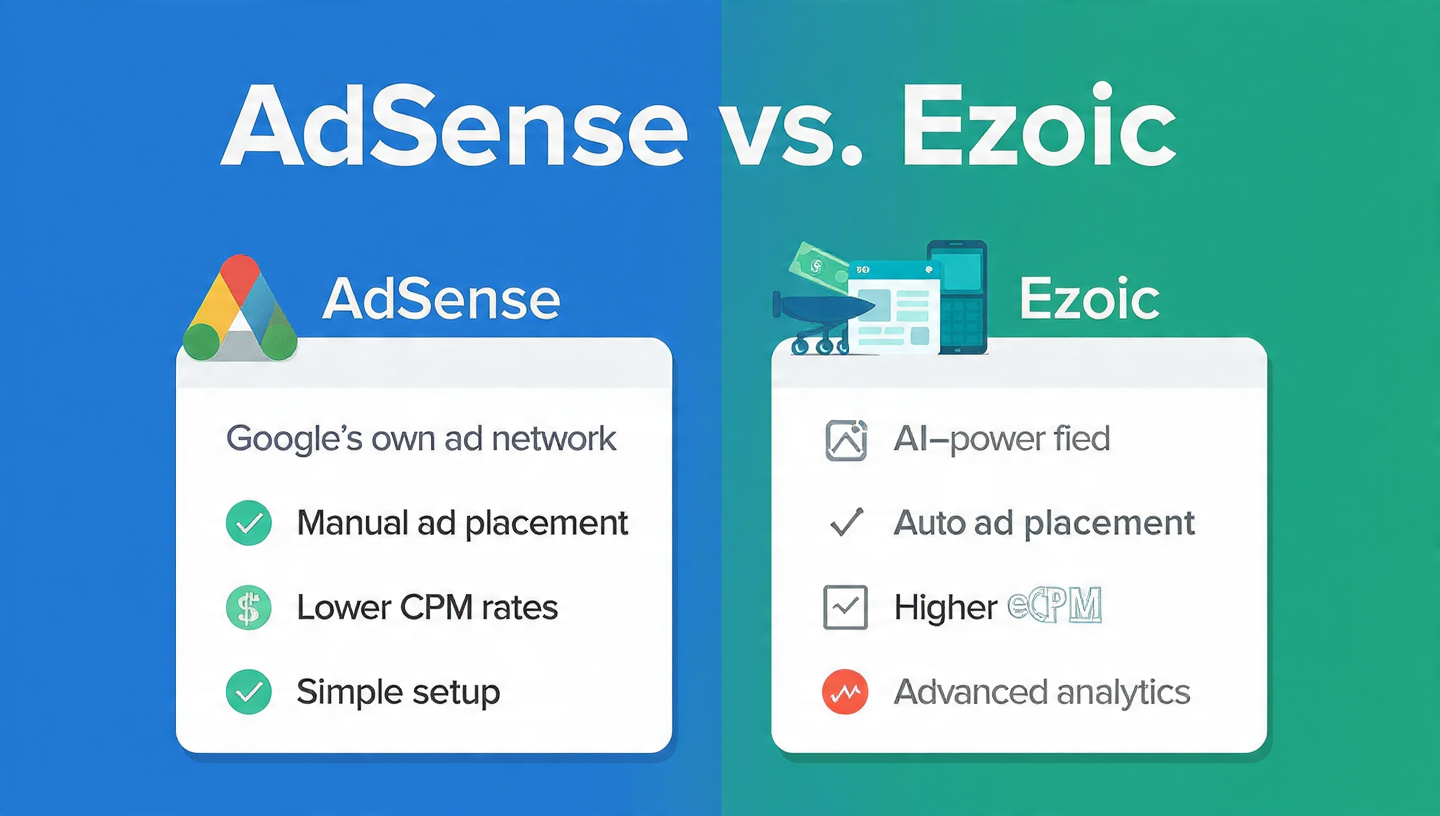
| Factor | AdSense | Ezoic |
|---|---|---|
| Setup Difficulty | Very easy 🟢 | Complex 🟡 |
| RPM (Earnings) | $1–$10 🟡 | $5–$25 🟢 |
| Traffic Requirement | None 🟢 | None (Access Now) 🟢 |
| Payment Threshold | $100 🟡 | $20 🟢 |
| Site Speed Impact | Minimal 🟢 | Can be an issue 🟡 |
| Support | Poor 🟡 | Good 🟢 |
| Learning Curve | Low 🟢 | High 🟡 |
| Control Over Ads | Low 🟡 | High 🟢 |
| Best For | Beginners, small sites | Growing sites, optimizing revenue |
The Bottom Line: Start with AdSense. Switch to Ezoic once you have consistent traffic (10,000+ sessions). That’s the smart path.
Thanks for reading all the way to the end. I know this was a long one, but I wanted to make sure you had all the information you need to make a confident decision.
If you found this helpful, maybe bookmark it and come back when you’re ready to make the switch. And if you have questions, drop them in the comments—I’d love to hear from you.
Now go build something amazing. The internet is waiting for your voice. 🚀

Previous Post