
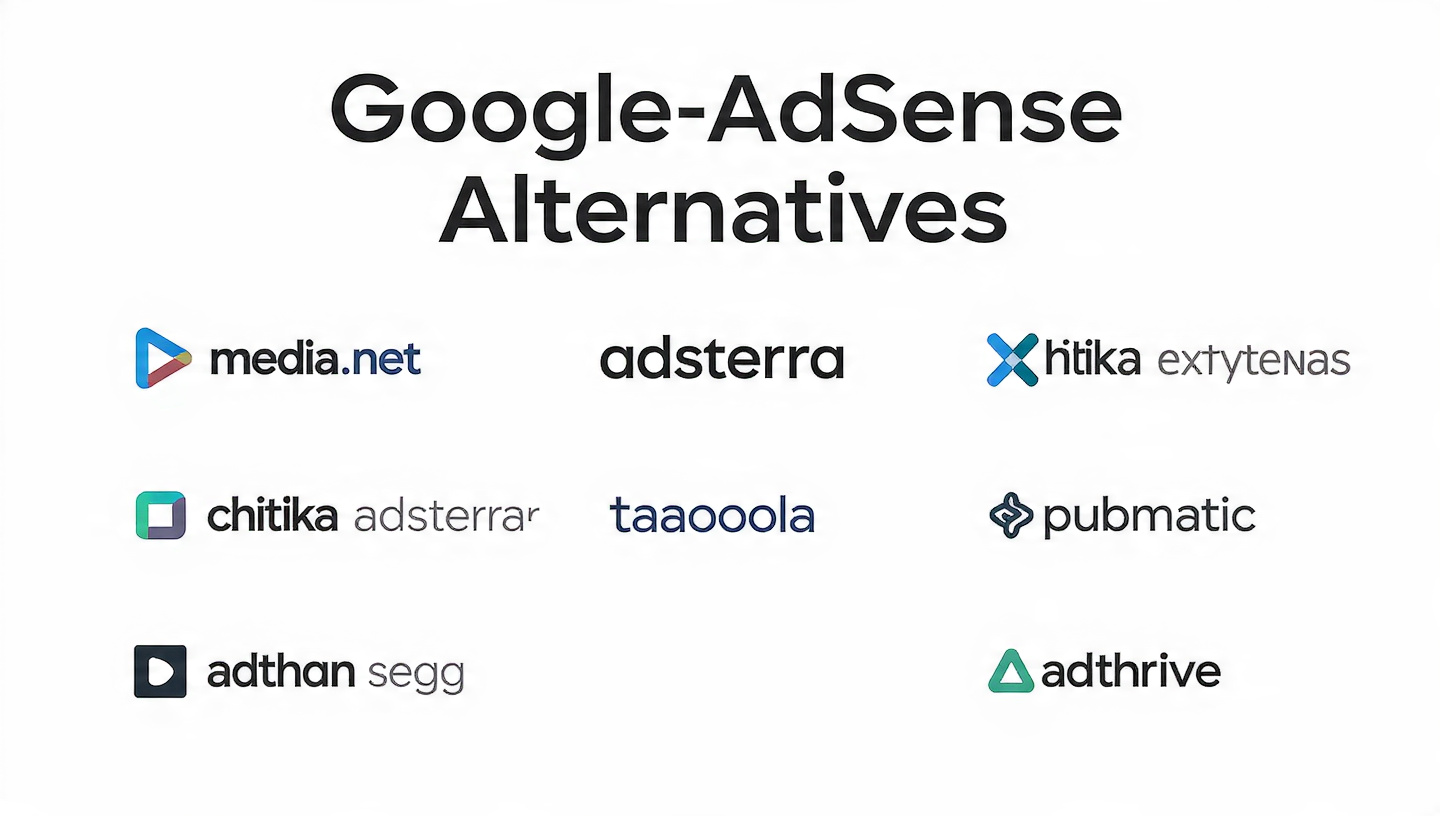
If you’re looking for Google AdSense alternatives that could pay more, the good news is that the landscape in 2026 offers excellent options for publishers at every stage. While AdSense remains a solid baseline with no traffic requirements , the real revenue growth happens when you move to platforms with more sophisticated demand and optimization.
Here are 7 ad networks that could pay you more than AdSense, organized by your traffic level and content type.
📊 Quick Comparison: 7 AdSense Alternatives
| Network | Best For | Traffic Requirement | Stated Share | Effective Take Rate | Key Strength |
|---|---|---|---|---|---|
| Mediavine | Lifestyle bloggers (food, travel, parenting) | 1,000 sessions/month (Journey tier) | 70-90% (tiered) | ~30-40% | Highest RPMs in lifestyle niches |
| Raptive | US/UK content creators | 25,000 pageviews/month | 75% | ~33-38% | RPM guarantee for qualified sites |
| Monumetric | Growing blogs (10K-500K range) | 10,000 pageviews/month | ~70-80% | ~30-35% | Dedicated account managers |
| Ezoic | AI-driven optimization | 250,000 monthly users | ~90% | ~36-40% | Incubator program for smaller sites |
| Clickio | Technical publishers wanting AdX access | 100,000 pageviews/month (Tier 1 countries) | Varies | Varies | Google Certified Partner, keeps your AdSense competing |
| Media.net | Contextual ads, Yahoo-Bing demand | Not disclosed (quality + Tier 1 traffic needed) | Not disclosed | ~$1-1.25 CPM reported | Largest contextual alternative to AdSense |
| EthicalAds | Developer/technical content | ~50,000 pageviews/month | 70% | 70% | Zero cookies, privacy-first |
🏆 Deep Dive: The Top Contenders
1. Mediavine: The Lifestyle Blogger’s Choice
Mediavine dominates the lifestyle content space and made a game-changing move in January 2026 by launching Journey, a tier that accepts sites with as few as 1,000 monthly sessions . Previously, their minimum was 50,000 sessions, so this opens premium monetization to many more publishers.
How it works: Mediavine uses a full programmatic stack with cookies and behavioral targeting. Ad formats include video ads, sticky sidebars, and in-content units that drive high engagement .
Revenue share: Tiered by earnings—Journey publishers get 70%, Official gets 75%, with higher tiers up to 90% for top earners .
Best for: Food, parenting, travel, home decor, and recipe bloggers with engaged US audiences.
The catch: The ad load can be heavy, impacting Core Web Vitals. It’s strongly optimized for US-centric lifestyle content, so developer or technical sites may see lower performance .
2. Raptive (formerly AdThrive): The Premium Performer
Raptive lowered its traffic requirement in late 2025 to 25,000 monthly pageviews (down from 100,000), though sites under 100K need at least 50% of traffic from Tier 1 countries (US, UK, Canada, Australia, NZ) .
How it works: Raptive offers a full-service managed solution with strong relationships with premium US advertisers. For qualified larger sites, they provide an RPM Guarantee, promising at least 15% RPM increases .
Revenue share: Approximately 75% programmatic share .
Best for: Content creators and blogs with predominantly US/UK traffic.
The catch: The Tier 1 traffic requirement means publishers with mostly non-English or developing market traffic may not qualify .
3. Monumetric: The Account-Managed Option
Monumetric (formerly The Blogger Network) caters to publishers in the 10,000 to 500,000 pageview range . They focus on delivering high-quality ads through direct advertiser relationships.
How it works: Monumetric uses a combination of display, video, and native ads with a focus on maximizing CPMs through dedicated account management. Every publisher gets a real person helping optimize performance .
Revenue share: Approximately 70-80% programmatic share .
Best for: General blogs with 10K-500K monthly pageviews that want hands-on support.
The catch: Lower effective take rates due to programmatic supply chain costs (estimated 30-35% of original advertiser spend reaches publisher) .
4. Ezoic: The AI Optimization Platform
Ezoic made headlines in February 2026 by raising its minimum to 250,000 monthly users—a dramatic increase from the previous 10,000 sessions . However, they offer an Incubator program that accepts approximately 20 publishers per month globally .
How it works: Ezoic uses AI to test ad placements and formats automatically, finding the optimal configuration for revenue without manual testing. Publishers can choose between an ad-funded model or a flat 10% fee model .
Revenue share: Approximately 90% stated share, with effective take rate around 36-40% .
Best for: Large content publishers who want AI-driven optimization.
The catch: The new 250K minimum means Ezoic is no longer viable for most small publishers. Existing publishers are grandfathered in, but new applicants face a high bar .
5. Clickio: The Google Certified Partner
Clickio is a Google Certified Publishing Partner (GCPP) that offers publishers access to premium demand sources including Google AdX (which normally requires 500M+ monthly impressions to access directly) .
How it works: Clickio integrates a single script that enables header bidding with 20+ demand partners (Xandr, Magnite, OpenX, PubMatic, Index Exchange, Criteo) while keeping your existing AdSense account competing in the same auctions . Their AI-driven floor price optimization adjusts minimum bids dynamically based on country, device, format, and user engagement.
Traffic requirement: 100,000 pageviews/month for Tier 1 countries (US, UK, France, Canada, Australia); higher for other regions. Sites generating $500+/month may qualify with less traffic .
Key features:
- Access to Google AdX through Multiple Customer Management (MCM)
- AI-powered floor price optimization
- Core Web Vitals monitoring to protect page experience scores
- 10+ ad formats including sticky units, interstitials, rewarded ads, and native placements
- Built-in Gold Google CMP for privacy compliance (GDPR/CCPA)
Best for: Technical publishers ready to maximize revenue through header bidding while maintaining AdSense as a competing demand source.
The catch: Requires more technical setup than fully managed solutions, though their single-script integration simplifies the process .
6. Media.net: The Contextual Powerhouse
Media.net is the largest contextual advertising network and the primary alternative to AdSense for publishers who want relevant, content-matched ads. It leverages demand from the Yahoo! Bing Network .
How it works: Media.net analyzes page content to match ads with relevant keywords that advertisers have bid on. It offers display-to-search ad formats that capture user intent .
Revenue share: Not publicly disclosed. Third-party sources report CPM earnings between $1 to $1.25 .
Traffic requirement: No publicly disclosed minimum, but websites need excellent quality content and steady traffic from Tier 1 countries (US, Canada, UK) .
Best for: Publishers who want high-quality, contextually relevant ads without behavioral tracking complexity.
The catch: The lack of transparency about eligibility requirements can be frustrating, and payment is in USD only (annoying for non-US publishers) .
7. EthicalAds: The Privacy-First Developer Network
EthicalAds takes a radically different approach: zero cookies, zero third-party tracking. Targeting is 100% contextual based on country and ML classification of page content .
How it works: One clean ad per page, no clutter, no consent banners needed. In January 2026, EthicalAds distributed $124,300 to publishers and projects over $500,000 across 2026 .
Revenue share: 70% to publishers, $50 minimum payout, paid monthly .
Traffic requirement: Approximately 50,000 monthly pageviews, with manual application review. The bigger gate is audience fit—your site must serve a technical audience (developer blogs, programming tutorials, open-source docs) .
Best for: Python/Django developers, open-source maintainers, documentation sites, technical blogs with 50K+ monthly pageviews.
The catch: Developer/technical niche only—not for lifestyle, food, or general content. Lower CPMs than programmatic networks, but you keep a much higher percentage of what advertisers pay .

💡 Understanding What “Pays More” Really Means
Before switching networks, you need to understand a critical distinction that most comparison posts ignore: what is the revenue share calculated on?
According to the Association of National Advertisers, only 44% of programmatic ad spend actually reaches publishers as working media. The other 56% is consumed by the supply chain .
Here’s what that looks in practice:
| Model | Advertiser pays | Supply chain takes | Network fee | Publisher receives |
|---|---|---|---|---|
| Programmatic (e.g., Ezoic at 90%) | $10.00 | ~$5.50 (55%) | $0.45 (10%) | ~$4.05 |
| Programmatic (e.g., Mediavine at 75%) | $10.00 | ~$5.50 (55%) | $1.13 (25%) | ~$3.38 |
| Direct (e.g., EthicalAds at 70%) | $10.00 | $0 | $3.00 (30%) | $7.00 |
The effective take rate—what percentage of the advertiser’s original dollar a publisher actually receives—is what matters. A “75% share” on a direct marketplace can pay nearly double what a “90% share” on a programmatic network delivers .
🎯 How to Choose Your Path
| If You… | Start With | Why |
|---|---|---|
| Have 1K-50K monthly sessions in lifestyle/food/travel | Mediavine Journey | Premium network access at entry-level traffic |
| Have 25K+ US/UK pageviews in content niches | Raptive | RPM guarantee, strong premium demand |
| Have 10K-500K pageviews and want hands-on support | Monumetric | Dedicated account managers |
| Have 250K+ monthly users | Ezoic | AI optimization at scale |
| Have 100K+ pageviews and want technical control + AdX access | Clickio | Keep AdSense competing with premium demand |
| Have quality Tier 1 traffic and want contextual alternative | Media.net | Yahoo-Bing demand, clean ads |
| Run a developer/technical blog with 50K+ views | EthicalAds | Privacy-first, keep 70% of actual spend |
🏁 The Bottom Line
AdSense is where you start. These 7 networks are where you scale.
The right choice depends entirely on your traffic, niche, and priorities. For lifestyle content, Mediavine’s Journey tier is the most exciting development in 2026. For technical audiences, EthicalAds offers unmatched transparency. For publishers ready to implement header bidding while keeping AdSense, Clickio provides Google Certified Partner access to premium demand.
Pro tip: Most successful publishers don’t choose just one. They layer networks—using a premium platform as their primary and keeping AdSense as a demand partner within header bidding setups .
 Previous Post
 Next Post